Summary
This rugged and often boggy walk explores a wild stretch of coastline. It has plenty of interest, from the memorials to the Arctic convoys that carried supplies to Russia during World War 2 to one of the finest remote beaches in Scotland. There are usually sheep present along the route - keep dogs under tight control.
Grade

Bog Factor

Rating
Distance
Time
(in summer)
Ascent
Terrain
Rough going; indistinct paths mostly, with some bog and pathless sections. Crossing the Abhainn na Leuma (Stage 8) may be impossible in spate, return by the outward route this might be the case.
Are you REALLY ready for winter hills?
Hillwalking when there is snow lying requires an ice-axe, crampons and knowledge of how to use them safely. The description here is for summer conditions.
See our Winter Skills page for basic information on the essential skills, techniques and knowledge needed for winter.
Getting there
Start
Car park at Rubha nan Sasan, by road end beyond Cove.
Public Transport
None to start.
Start Grid Ref
NG802926
Stage 1
There is a dedicated car park off to the left from the B8057 road end from Cove. The walk proper begins through the gate at the end of the parking area, but before setting off head back to the road end and turn left up the hill to visit the Rubha Sasan searchlight and gun emplacements. Over 200 men were based here during World War 2 - charged with protecting the Arctic Convoys which carried supplies to Russia, and which mustered here in Loch Ewe. Over 3,000 men died on the convoys, attempting to make what Churchill described as 'the worst journey in the world'. If you fork left there is a memorial stone and seat at the hill top, or fork right for another seat looking across Loch Ewe to the mountains.

Stage 2
Return to the car park, and head through the gate onto the rough coastline to begin the walk west. Cross the ground at the back of the bay and then pick up a path through the bracken beyond. There are a multitude of sheep paths and trods; pick the best line and continue by the coastline. There are low cliffs, impressive slabs rocks and shallow caves in the coast; the going is boggy in places and rocky in others. Continue working your way around the coast.

Stage 3
After a little over 2km from the car park there is unexpectedly a seat and plaque on the coast, looking out to Eilean Furadh. In February 1944 the USS William H Welch struck the island when heading to join one of the convoys. A fierce storm prevented the use of the lifeboats, and it took a heroic effort by locals to save 12 out of the crew of 74 - the rest were lost; there are still some fragments from the lifeboats on the rocky shore. Continue the walk along the coast, making your way around the headland of Stac Ruadh.

Stage 4
Eventually the broad bay of Camas Dubh is reached, backed by areas of rounded pebbles and greensward. Head part way across this, looking out for the indistinct start of a track heading inland. Take this track, which becomes clearer and passes to the right of Lochan Dearg. The track is mostly easy to follow apart from a couple of sections where it is lost to the bog; it passes left of Lochan Clais an Fhraoich and crosses the outflow of Loch an Draing on a broken causeway of stones.

Stage 5
The track passes through the edge of an area of old birches which have survived overgrazing by too many deer. The track continues up to join the Doire Dhubh path coming in from Midtown, but the last stretch up to the path is lost to the heather - make your way up to the fence and step over to join the path along the far side. Turn right along this, passing the ruins of the settlement at Lochadraing, and continue along the path to Camustrolvaig, another old settlement. One of the ruins here has been restored as an open bothy, sometimes known as Ivor's bothy (it is maintained by Ivor, not the MBA - please respect it).

Stage 6
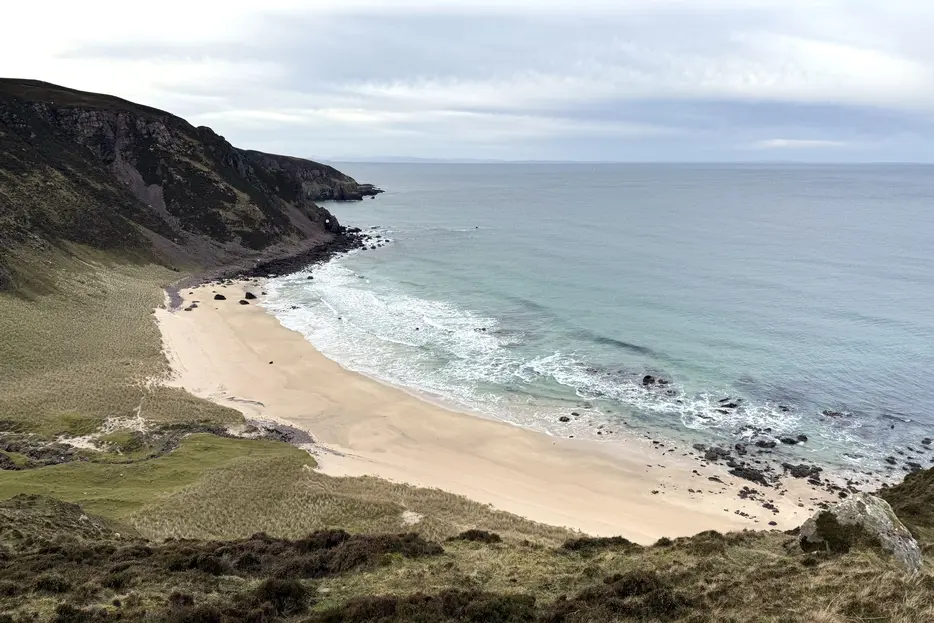
Just beyond Camustrolvaig is a memorial to Innes Ireland, a racing driver who was the first Scot to win a Grand Prix - presumably placed here due to his love of the location. The memorial overlooks the wonderful Camus Mor - one of the finest wild beaches on the west coast.

Stage 7
The slope down to reach the beach is steep, but there is a rough path from near the memorial. Though much smaller than the more celebrated Sandwood Bay, Camas Mor is even more remote and less visited. Enjoy the beautiful sands - but be aware of the long walk back! It's best to return back up the cliffs using the descent path.

Stage 8
It is possible to make a linear walk by continuing along the clifftops to join the route from Rubha Reidh - but transport would need to be arranged. To return to the start, you can either retrace your steps, or head back closer to the coast as described here. The coastal route has only the faintest bits of path and crosses a couple of sections of peat hags. Crossing the Abhainn na Leuma could be impassable in spate - in such conditions it's safer to stick to the outward route.

Stage 9
After crossing the river there is a craggier section of coast before the outward route is rejoined at the bay of Camas Dubh. From here continue retracing your steps back past the memorial and along the coast all the way back to the car park.

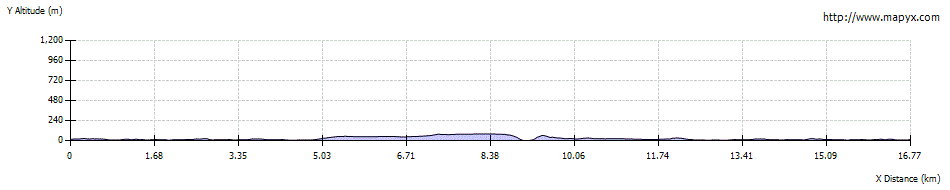
Route Profile