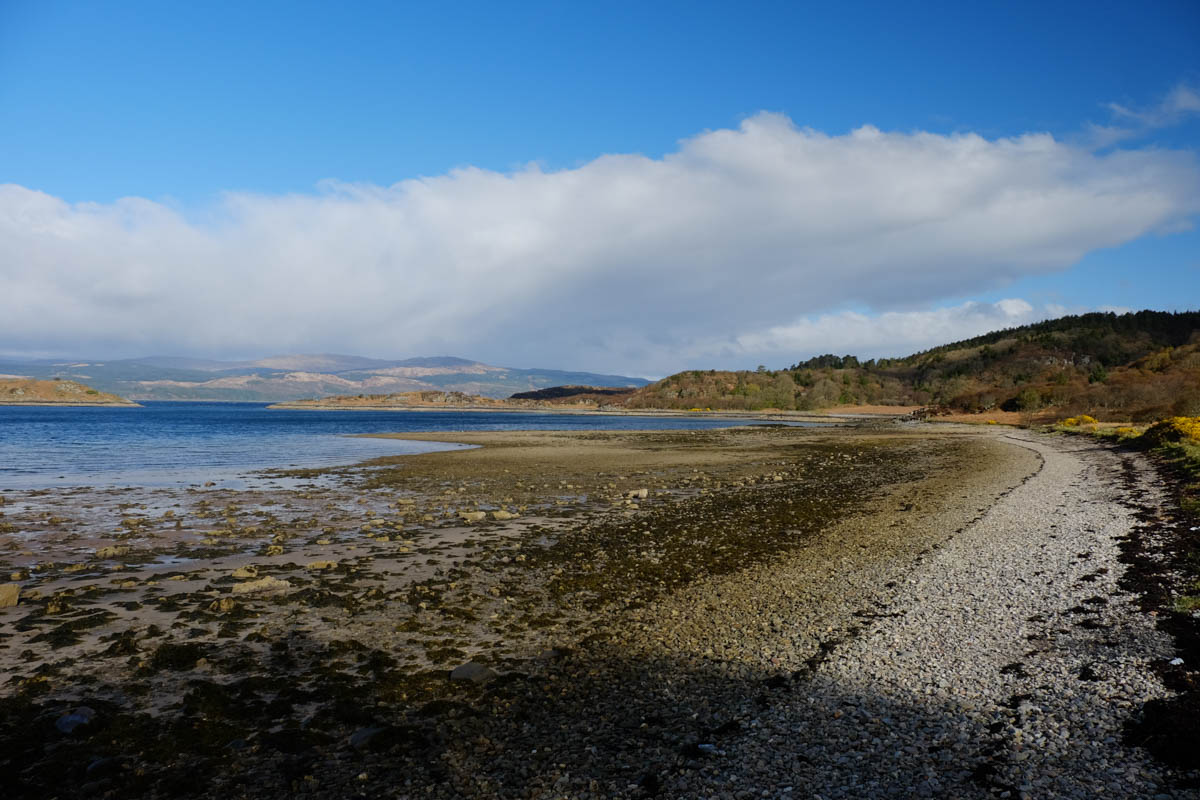
This fine shorter walk passes through oakwoods and climbs up to the abandoned village of Glenan, a lonely spot, as well as visiting an attractive bay.
Summary
Woodland and shore paths; some sections can be very muddy at times
Terrain
Users'
rating
Portavadie is served by bus and also by a ferry from Tarbert on the Kintyre peninsula.
Open Traveline Scotland
Public transport
1. The walk begins from the Glenan Forest Nature Reserve car park, on the north side of the road a short distance from the ferry pier. Information boards give details of both the walks and the reserve; the native oak and birchwoods here form one of the most northerly habitats for the nightjar. Go through the gate and head across the grassy field; a picnic table by the shore overlooks the ferries as they come into the jetty across the little bay.
2. The path begins just past the picnic table and runs right beside the shore at first before heading into the trees and reaching a junction. From here to Glenan Bay two paths form a loop so the alternative can be used for the return walk; fork right and take the Forest Path first. This crosses a tiny bridge and climbs through the atmospheric woodland; the trees are mostly fairly stunted and hung heavily with lichen. The path, which is very muddy in one or two places, ascends and winds about before a view of Glenan Bay is revealed ahead.
3. Follow the path down to another junction. The shore path heads back left from here, but first it is worth taking a detour on the path to the right to see the abandoned village of Glenan. The path crosses several wooden boardwalks and some muddy sections but is generally good as it heads up the right hand side of the glen. Eventually it descends to the burn which can be crossed either on the (slippy) rocks or a plank bridge just beyond.
4. On the other side the path climbs briefly to reach the ruins of Glenan. The settlement here is thought to date back to 1309 and was still inhabited many years after the Highland Clearances had led to many other villages being abandoned. The last inhabitant is thought to have left Glenan at the beginning of the twentieth century, though some local legends tell that he hung himself in the oakwoods below. The remains of several houses are still clearly visible and this is a haunting place to sit and imagine what life must have been like in harder times.
5. Return from the abandoned village back down the path to the junction mentioned earlier; this time keep right to follow the shore path, forking left next to an isolated piece of fencing. The grassy path heads down to the pebbly shore of Glenan Bay. Usually you can walk along the shore just below some sloping rocks but if the tide is right in it is necessary to take a rough inland path to avoid these crags. If following the shore, once past the rocks look out for the path heading into the bracken once more. Over to the right is a narrow isthmus leading to Eilean na Beithe - not quite the island that the name suggests.
6. Continue on the path that winds around some big boulders and broken crags, passing through more oak woodland with strangely contorted trees. The route soon leads back to the signed junction near the start of the walk; continue ahead to reach the picnic table and the car park beyond.
Have you found an error or is any information wrong or missing?
Please let us know by using the error report form.