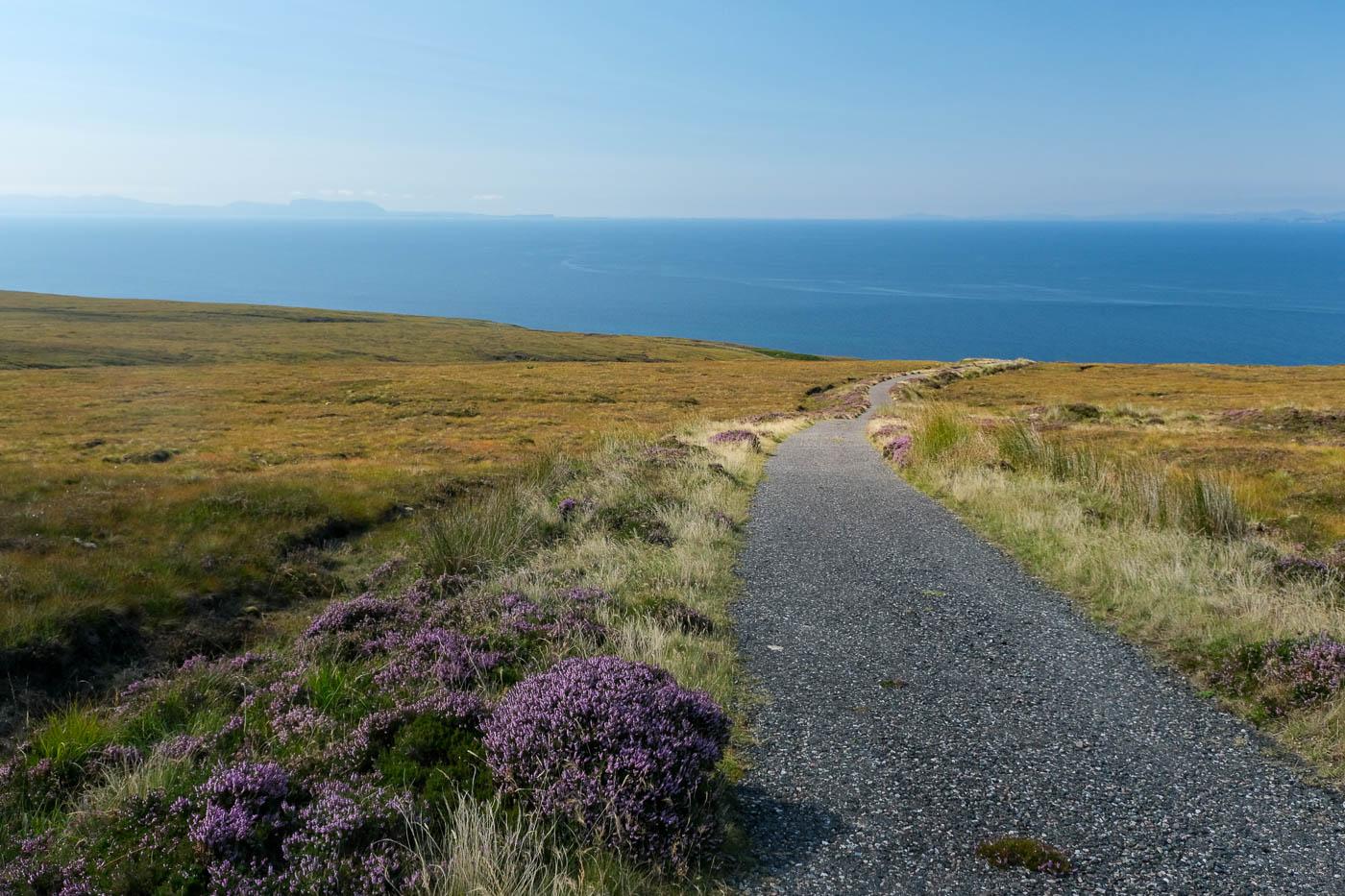
An easy walk at first along the coastal road, with good views to Skye, leading to Rubha Reidh lighthouse. Continuing around the coast on narrow cliff paths is much tougher but gives views of amazing natural arches and the beach at Camus Mor. The route then climbs over heather moorland and bog to the mast at Maol Breac before returning to the coast road. An easier option would be to walk to the lighthouse and back, perhaps exploring a little further along the coast as well.
Summary
Minor road, very rough and exposed cliff path, rough, pathless moorland section with peat bog.
Terrain
Melvaig - parking area near end of public road.
[Map of start point,
satnav coords and directions]
Start
Maps
Users'
rating
1. There is limited parking at Melvaig just before the end of the public road; the road on from here to the lighthouse is private. The lighthouse at Rubha Reidh houses a hostel (providing evening meals to non-residents) and outdoor centre and by summer 2009 will have a small visitor centre with telescope. From Melvaig walk up the road (looking back down the coast for excellent views) and follow it north. Looking west, the Trotternish peninsula on Skye is clearly visible and as you walk north, the Shiant Islands and beyond them the Western Isles can also be seen on a clear day.
2. Keep on the road, crossing two bridges and ignoring the track heading up to the right which leads to the masts at Maol Breac - this will be the return route. After almost five kilometres the lighthouse is reached at last. Built by David Stevenson, a cousin of Robert Louis Stevenson, in 1910, the lighthouse has been operating since 1912 and is now fully automated. The headland here is a good spot to look for Minke whales in the summer months and breeding sea birds on the nearby cliffs. Basking sharks, dolpins and porpoises have also been spotted along with more common seals.
3. Head down the road towards the lighthouse and take the road to the right blocked by white stones. This soon leads to a landing jetty, the only way to the lighthouse, apart from on foot, until the road was built in 1962. The steep incline used to have a winch and trolley system, the remains of which can be seen in the bottom of the inlet as you pass around the cliffs. Climb back up from the jetty and turn left onto a narrow path that skirts the edge of the cliff. Try and keep to the main, higher path and do not be drawn onto narrow sheep paths that often lead dangerously close to the edge of the eroding cliffs.
4. After a while the path becomes clearer and soon the large sea stacks and natural arch can be seen ahead. From the viewpoint here make sure you take the high path that heads directly up the cliff, inland, away from the edge. Keep following the path as it undulates over the bumpy headland.
5. After heading in land a short way to cross a stream continue along the path. Soon the beach at Camas Mor comes into view and more pinnacle shaped stacks below. The beach can be visited as a strenuous detour by keeping on the cliff path, passing an old building, until the far side of the bay is reached and a path winds down the grassy slope on the easiest ground. This is still steep and makes a hard climb on the way back.
6. Continuing on this route, when you reach the highest ground on the cliff behind Camas Mor (Grid Ref NG757899) head inland south south east, always heading for the highest ground in this direction. Initially the ground is fairly easy going turf, which then develops into heathery peat hags and eventually once the masts come into view, there are frequent boggy sections. Once the masts are reached at Maol Breac, which is a good viewpoint, head down the road to reach the lighthouse road through a gate. Turn left and follow the road back to Melvaig.
Have you found an error or is any information wrong or missing?
Please let us know by using the error report form.