Summary
This fine circuit begins with a climb over moors revealing stunning views across the Clyde islands; it then descends to the remote cottage at Laggan for a return along a rugged section of the Arran Coastal Way.
Grade

Bog Factor

Rating
Distance
Time
(in summer)
Ascent
Terrain
Rough bouldery paths, some wet sections and easy rock scrambling on the Coastal Way at An Sgirodain.
Are you REALLY ready for winter hills?
Hillwalking when there is snow lying requires an ice-axe, crampons and knowledge of how to use them safely. The description here is for summer conditions.
See our Winter Skills page for basic information on the essential skills, techniques and knowledge needed for winter.
Getting there
Start
Parking at NR937506 where minor road reaches shore.
Public Transport
Bus to Lochranza Field Studies Centre.
Start Grid Ref
NR937506

Stage 1
The walk begins from the minor road which branches off opposite the field study centre (bus stop) and church in Lochranza. The best parking is where the road means the loch shoreline. There are great views across the water to Lochranza Castle. Begin by heading back along the road towards the junction where you turned off. When the road turns sharp right, keep straight ahead onto a lane.

Stage 2
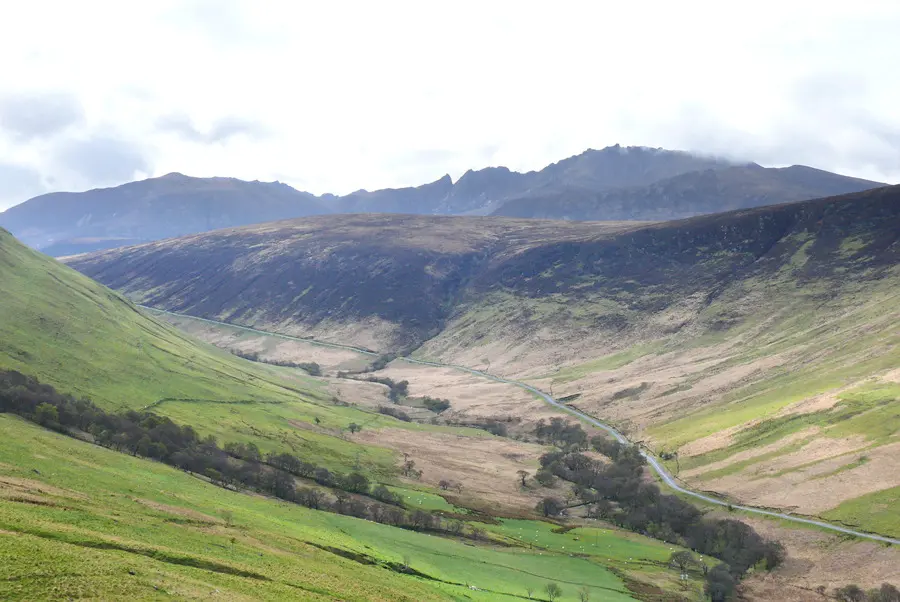
The lane leads uphill past a succession of house with envy-inducing views across the glen to rugged Creag a' Chaise and Torr Nead an Eoin. After 1km leave the road by a grassy path forking left adjacent to an interpretation board. This path is the historic route to Cock Farm from the village and begins a gentle ascent through the grazing land of Glen Chalmadale. There are soon great views back down the glen.

Stage 3
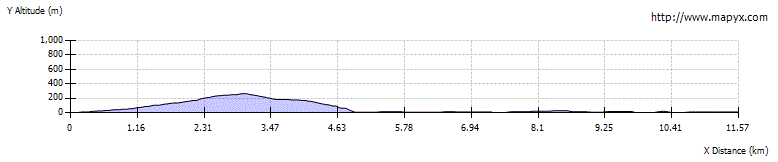
Cross a footbridge over pretty Allt Eadaraidh and continue onwards until the path levels out at the pass of Bearradh Tom a'Muidhe at 263m. There is never any doubt as to the correct route, so enjoy the unfolding views along the glen to The Witches Step and Caisteal Abhail as the immediate terrain changes from lush farmland to rough heather moorland. The views from this point are stunning, with the small island of Inchmarnock in the foreground overshadowed by Bute and the Cowal Peninsula.

Stage 4
The path bears right to reveal ruined Cock Farm far below. Pre-Clearances the area between Laggan Cottage and Cock Farm once housed in excess of 100 inhabitants - hence the substantial path over the pass - but now lies deserted. Malcolm Macmillan, the grandfather of Daniel Macmillan of Macmillan publishing fame was born on Cock Farm in 1735. His son, Maurice Crawford Macmillan married Helen (Nellie) Artie Tarleton Belles, whose son Harold became British Prime Minister in 1957. Cock Farm was abandoned in 1912 and now lies abandoned at the end of a grass track dropping steeply down to the left.

Stage 5
Follow the main path as it contours below the crags of Creag Ghlas Laggan before descending more directly to whitewashed Laggan Cottage above a rocky shoreline. Now turn left to follow the obvious coastal path, past the ruins of a small mining and salt panning operation complete with millstone. The path becomes rockier and boggy as it passes a small wood and some of the ruined mining buildings.

Stage 6
The route detours onto the pebbly shore to avoid a short boggy section. Further on pass a huge sandstone boulder (with a Coastal Way post next to it), the Cock of Arran which used to more closely resemble a cockerel when seen from the sea but its head has been gradually eroded. The path climbs to keep above much of the An Scriodan boulders which tumble into the sea here. The path, although much improved recently, still requires some minor scrambling over rocks until a series of rocky steps brings you back down to the shore at a finger post.

Stage 7
An easy grassy path leads to the cottage at Fairy Dell where there was once a small fishing community and a number of buildings. Cross the stream and ignore the path heading up to the left and continue along the shore. It soon passes Hutton's Unconformity, where the pink sandstone can be seen next to granite of a different age. This is just one of the sites at which geologist James Hutton (1726 - 1797) first identified the evidence leading to the notion that the earth had evolved over an immense period of time.

Stage 8
Follow the path along the shore to Newton Point where there is a view indicator. The houses and ferry terminal of Lochranza can be seen across the water. The path soon reaches a road, follow this past houses on the northwest side of Loch Ranza looking out for seals and herons at low tide here. Soon it leads back to the parking area at the start of the walk.
Route to Laggan: Phil Turner

Route Profile