Summary
In 2022 Dunfermline became Scotland's newest city - yet its history is long and illustrious, and is the final resting place for seven Scottish Kings. This walk explores the heritage around the town centre, beginning in lovely Pittencrieff Park (known to locals as the Glen), and visiting historic buildings including the Abbey, the Abbots House, the birthplace of Andrew Carnegie and St Margaret's Cave.


Terrain
Surfaced paths, pavements and roads; some steps.
Getting there
Start
Pittencrieff Park car park.
Public Transport
Dunfermline is well served by trains and buses.
Start Grid Ref
NT084872

Stage 1
The walk is described from the Pittencrieff Park car park, but if arriving by public transport you can join it in the centre. Go through the main part of the car park and continue to reach the furthest parking area, which is behind the Glen Pavilion. Begin the walk by passing the Glen Pavilion - a beautiful art-deco building - and then turning left alongside it. The older part of the building is a venue for events, but there's a cafe in a modern extension overlooking the park - the Peacock Rooms.

Stage 2
At the junction by the cafe, the walk continues straight ahead. The striking old building on your left is Pittencrieff House, which dates to the 17th century, and originally belonged to the Abbey, but eventually came into possession of Dunfermline's most famous son, Andrew Carnegie, who donated both it and the park to local residents in 1903. For many years it was a museum, but is currently closed. Continue straight ahead, passing along the right side of the glasshouses which are open to the public; the more formal part of the gardens is on your right. At the end of the glasshouses turn right, passing a row of benches, and then left through an archway.

Stage 3
Go almost straight across the tarmac path, taking the path into the trees. When steps are reached on your right, turn to head down them. The route now descends into the Glen, which has become the residents name for the whole of Pittencrieff Park. Cross the bridge at the bottom and turn right to follow the path by the burn. Eventually the path forks - take the left branch, then go left again at a cross-paths by the childrens' play area - signed for the Andrew Carnegie Birthplace Museum and Moodie Street.

Stage 4
The path ascends some steps and then emerges at a parking area, with the Carnegie Birthplace museum diagonally opposite. The actual birthplace cottage is now dwarfed by the museum attached. Andrew Carnegie was born here in 1835; he emigrated with his parents when he was 12 and led the expansion of the American steel industry and became one of the richest men in history. Today he is best known for his philantrophy; in 1889 he wrote an article calling on the rich to use their wealth to improve society, and expressed support for progressive taxation and an estate tax. He built New York's Carnegie Hall, just one of hundreds of buildings and institutions around the world to bear his name. Bear left to pass his birthplace, and then keep ahead onto St Margaret's Street.

Stage 5
You are now in the historic heart of Dunfermline; take the next left onto Monastery Street. The path leads alongside and then through an archway in the ruins of Dunfermline Palace, once a residence of many Scottish kings. In the 11th century Malcolm III made Dunfermline his capital; his seat was the nearby Malcolm's Tower, a few hundred yards to the west of the later palace. The existing ruins are from when the building was remodelled by James IV around 1500. Charles I was born here in 1600; he was the last monarch born in Scotland.

Stage 6
Pass through the archway; Dunfermline Abbey is now on your right. Founded as a priory, Dunfermline was declared an abbey by King David I and became a royal mausoleum. There's a charge to enter the very fine Romanesque nave. Scotland's national hero, Robert the Bruce, is interred here, though his heart was buried at Melrose Abbey; his name is carved proudly into the tower. After visiting the Abbey, take the next turning on the right onto Maygate.

Stage 7
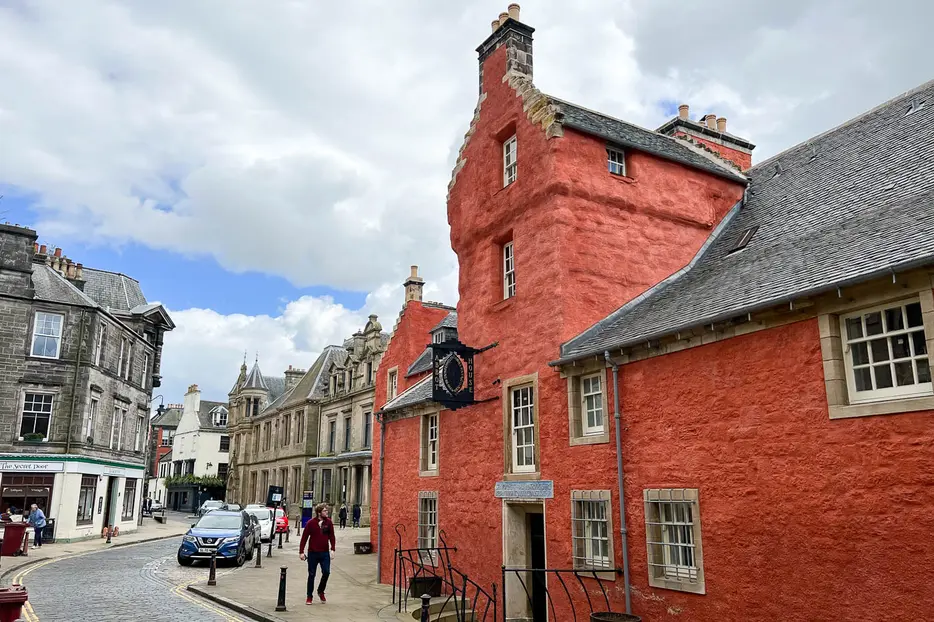
The beautiful building on your right is the Abbot House, thought to be the oldest in Dunfermline. It is currently undergoing internal renovation prior to reopening to show off its rich history; it also has a beautiful garden. The interior includes murals painted by the renowned novelist and artist Alisdair Gray. Continue along the road, passing the Dunfermline Carnegie library, which was opened on 29 August 1883 and was the world's first Carnegie Library. Keep straight ahead at the crossroads along Canmore Street, continuing until the t-junction with New Row. On the right is the Alhambra Theatre, which opened in 1922.

Stage 8
Turn left along New Row, and then left again to head along Dunfermline's pedestrianised High Street. Note the fine Mercat Cross, topped by a unicorn; it dates to 1620. Continue to a cross-roads, with the Victorian Dunfermline City Chambers looking very impressive. Turn right onto Bruce Street. Alongside an old church turn left down an alley to reach a car park. On your right here is a small building which houses the entrance to St Margaret's Cave. Margaret was a Saxon princess born in 1047, but became Queen of Scotland when she married King Malcolm Canmore in Dunfermline. She was made a Saint by Pope Innocent the Fourth in honour of her life and the miracles associated with her after her death. The cave has not yet reopened following the Covid pandemic.

Stage 9
Cross the car park from the cave and leave from the far side to head up to Chalmers Street. Turn left along this, and then right to head through the Louise Carnegie Memorial Gateway into Pittencrieff Park once more. Keep straight ahead, soon passing a huge statue of Andrew Carnegie. Beyond this, take a path that forks left, then turn left to continue through the park. A playpark is off to your right. Soon the route returns to the Peacock Rooms Cafe and the Glen Pavilion - head back to the start of the walk.

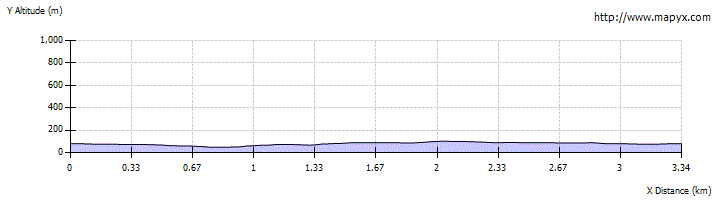
Route Profile