Summary
Traditionally a place of recreation for Edinburgh residents, Calton Hill, with its numerous monuments and buildings is popular as a fine viewpoint over the city.


Terrain
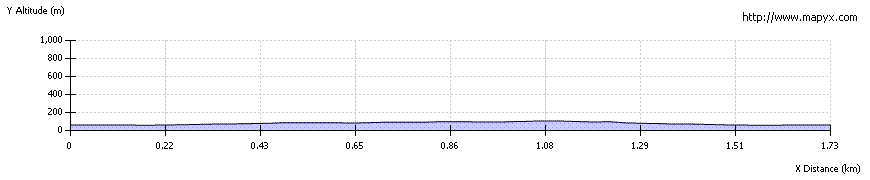
Roads with pavement, surfaced tracks and paths. Long flight of steps.
Getting there
Start
Waverley Steps exit from Waverley Rail Station.
Public Transport
Train to Waverley Station, buses alight here at east end of Princes Street.
Start Grid Ref
NT257739

Stage 1
From Waverley Station turn right on Waverley Bridge to reach Princes Street, or take the direct Princes Street exit. If walking or arriving by bus start the walk next to Waverley Station at the east end of Princes Street, between East Princes Street Gardens and the imposing Balmoral Hotel. From here continue along Princes Street, passing the Balmoral Hotel, a landmark building with a beautiful clock tower on the right and one of many of Edinburgh's flagship banking buildings on the left. Cross the road, now Waterloo Place, and continue slightly uphill until a set of steps is reached on the left.

Stage 2
At the top of the steps continue straight ahead on the surfaced walkway, ignoring the steps to the right and curving round to the right on the north side of the hill for a superb view over Leith and the docks and across the water to Fife. Calton Hill was developed as one of the first public recreation spaces in the crowded city. In 1775, the philosopher, David Hume, petitioned the Town Council to provide a walkway for the benefit of the population and the first public walk was duly opened. When Hume died the following year his remains were laid to rest in Old Calton Burying Ground on Waterloo Place at the foot of Carlton Hill - it can be visited on the return part of this route. Hume's epitaph reads, 'Born 1711, Died [----]. Leaving it to posterity to add the rest.' The burial ground also houses the Political Martyrs Monument, in memory of 5 sympathisers of the French Revolution who were transported to Australia in 1793. Continue along Hume Walk until another walkway crosses - go straight ahead here uphill.

Stage 3
Soon there are great views over the south side of the city to be enjoyed. The huge lump of rock that is Arthur's Seat dominates the view, with the roof-tops of the Scottish Parliament building at Holyrood and the white armadillo-shaped dome of Dynamic Earth science centre. Calton Hill was itself a rallying point for supporters of Scottish self-governance with vigil held here for many years. The neo-classical building with columns and domes seen below is the Royal High School. Built in 1829, the building was earmarked as the new Scottish parliament ahead of the referendum in 1978. The referendum was lost and the building is now used by Edinburgh Council and the much larger Scottish Parliament build at Holyrood once devolution became a reality in 1999.

Stage 4
From the seat head west uphill on the rough path towards the Nelson Monument. Built in 1807 to resemble Nelson's telescope, you can pay to climb the stone spiral steps for an even better view of the Castle and city itself. Even from the viewpoint at the bottom there are good views down the length of Princes Street, with the spire of the Waverley Monument in the foreground. Slightly to the south west the size of Edinburgh Castle and the great mound of rock on which it is built can be appreciated. From this point take the path down past the back of the Nelson Monument to the National Monument.

Stage 5
Started as a replica of the Parthenon in Athens in 1826, it was built to commemorate the dead of the Napoleonic Wars, but was never completed as money ran out in 1829. It has however served as a style icon for the city and influenced many of the more recent architecture. From here face the Princes Street once more and head towards the Observatory House, keeping on the walkway just to the left of the building which leads to a good viewpoint.

Stage 6
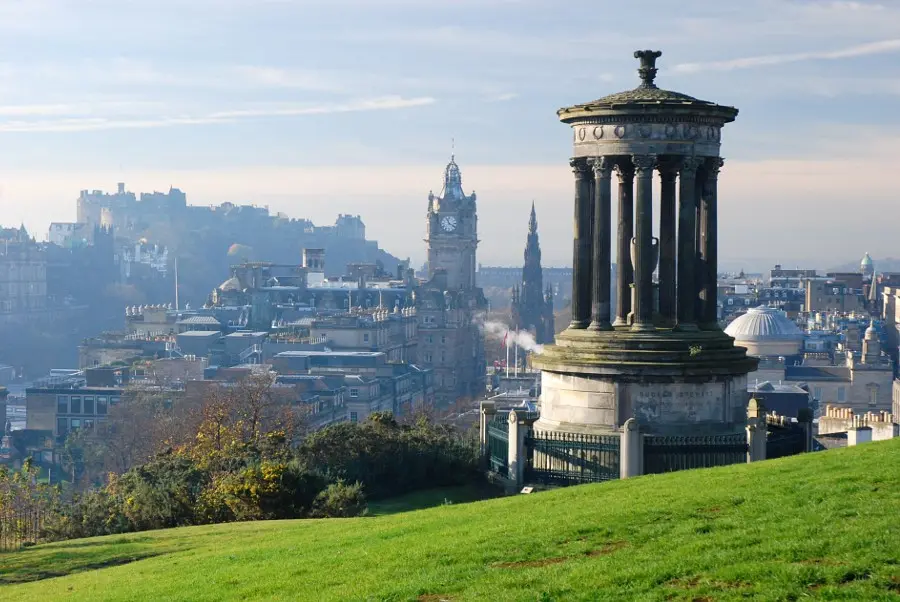
To the left is a cannon and the much photographed circular Dugald Stewart Monument. Its design, with elegant Grecian columns was by William Henry Playfair, and it commemorates Stewart, a Scottish philosopher at Edinburgh University from the mid 1780's to his death in 1828. Playfair was also one of the driving forces behind the City Observatory, completed in 1822. From here take the walkway and steps down past the Dugald Stewart monument to return to Waterloo Place at the bottom of the hill. Turn left and follow the pavement past the Royal High School building and once opposite the circular Playfair Monument, bear left along Regent Terrace. Designed by William Henry Playfair, this elegant street of large townhouses was orignally home to some of the wealthiest whisky and wine merchants in Scotland.

Stage 7
As the street curves round into the Royal Terrace the largest houses can be seen. These were particularly favoured by merchants who claimed to be able to see their ships arriving at the docks in Leith. Follow the cobbled street down to the large junction with busy Leith Walk and turn left uphill. This important thoroughfare links the docks at Leith with the city and is a noisy and vibrant contrast to the relative peace of Calton Hill. Pass the Playhouse on the left, and then the Vue Omni entertainment centre with its huge metal giraffes outside. Cross the road at the crossing opposite the entrance to John Lewis and continue uphill to reach the east end of Princes Street and the starting point for the walk.

Route Profile