Summary
Starting from Ocean Terminal in Leith, the shopping mall where the Royal Yacht Britannia is berthed and can be visited, this short route explores the old docks, and the newly regenerated quayside buildings of Edinburgh's old port. As the route heads along a short section of the Water of Leith many restaurants and bars are passed.


Terrain
Pavements and waterside walkways, roads to cross.
Getting there
Start
Ocean Terminal, Leith.
Public Transport
Bus to Ocean Terminal from Edinburgh city centre.
Start Grid Ref
NT267771

Stage 1
Leith is the port of Edinburgh, sitting at the mouth of the Water of Leith on the Firth of Forth. The area's prosperity was built on ship building, whaling, and import and export trades. Most of the docks are no longer operating and after a period of decline, when the area was known for the seedier side of Edinburgh life, Leith has undergone a regeneration, with large offices housing the Scottish government bureaucrats and other white collar workers and new housing, restaurants and shops being developed. Ocean Terminal is a large shopping mall that also houses restaurants and the Royal Yacht Britannia. Used by the British royal family until 1997, it is now a visitor attraction accessed from the 2nd floor of the building. Ocean Terminal is easily accessed by frequent buses from the centre of Edinburgh and there is also free parking. Start the walk at the front of the building, towards the far end, and head along Ocean Drive opposite.

Stage 2
This road passes some of the large docks that were the mainstay of Leith's importance as an dock and shipbuilding centre. After the first dock on the right, turn right alongside it and then left to reach the blue-painted iron cantilevered bridge over the mouth of the Water of Leith. Cross this bridge and then turn right along the waterside walkway, past the old lighthouse, to the open square in front of the old sailor's home building which is now a Malmaison hotel. At the waterside is an old harpoon from the former Leith-based company, Christian Salvesen, which from 1910 onwards had one of the largest whaling fleets. Whaling from Leith ceased in the 1960's, but a reminder remains in Edinburgh zoo - the first penguins were brought there aboard whaling ships.

Stage 3
The fine building at the back of the square (now Malmaison) was built in 1883 to provide accommodation for sailors whose ships were in port, the angel above the door is the emblem of the Seaman's Mission. Keep following the waterside, passing the Signal Tower, which dates from 1685 and was used to relay messages to incoming ships.

Stage 4
Pass the moored boats and continue straight ahead at the crossroads to pass the King's Wark building. The present building stands on the site of a tenement built by King James I in 1438 to encourage trade at the port. It housed accommodation for merchant, shipbuilder's workshops, warehouses and taverns. Over the intervening years the buildings have also been used to house weapons, concalescing victims of the plague, and once boasted a tennis court. Nowadays it is a bar.

Stage 5
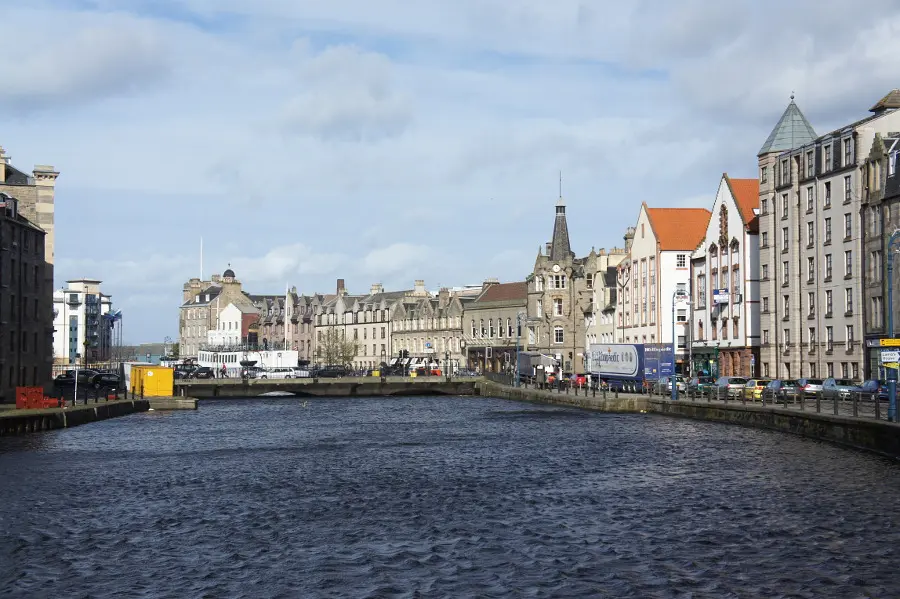
Keep following the waterside, there is a good view looking back out to sea of the tall quayside buildings. At the bridge on Sandport Place turn right to cross the water. The Water of Leith walkway heads off left on the far side, but for our circuit turn right to follow the far bank back towards the sea, passing a mixture of old and new buildings. At Commercial Street cross straight over (at busy times you may need to detour to the nearby crossing) and then turn left along the pavement.

Stage 6
Take your next right turn, then turn left to head beneath the archway with the ornate metal fish, keeping to the left side of the water and passing a number of restaurants.

Stage 7
The large building on the right houses the civil servants working for the devolved Scottish Government. Keep straight ahead passing behind the old warehouse buildings which are now a mixture of flats and commercial premises, old tramlines can still be seen on the ground. Soon Ocean Drive is reached, cross over and turn right to return to the start.

Route Profile