
As summer approaches Liz Murray and Norman Lannigan from the Lyme Resource Centre, based in Fife, take a dive into the undergrowth to explain how best to deal with ticks in the Scottish countryside.
The health gain derived from enjoying outdoor pursuits far outweighs the risk to health from a tick bite. Ticks should be respected not feared. But it’s important to know how to minimise the chance of a tick bite, deal with a tick bite safely and recognise the early signs of Lyme disease.
About Ticks and Lyme Disease
Spending time in grassy or wooded areas anywhere in the UK carries a risk of tick bites and potential exposure to Lyme disease. The UK Health Security Agency (UKHSA) monitors the threat of tick-borne diseases and data highlights that ticks have increased in number and distribution over time, presenting a growing public health threat.
Lyme disease is caused when an infected tick passes on the infection via a tick bite. On average, around 4% of UK ticks are infected with the bacteria that causes Lyme disease (Borrelia) – this can be up to 10% in some areas and the Scottish Highlands are a recognised tick ‘hot spot’. Since UKHSA data collection began in 2005, there has been a gradual increasing trend in cases of Lyme disease in the UK.
Ticks can be tiny and their bites are painless, making them easy to overlook – the image of ticks beside a one penny coin shows just how small they can be.
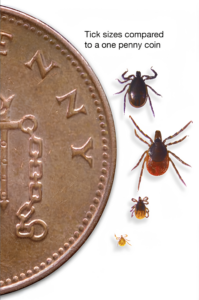
Ticks are found in woodland, grassy areas, fields and moorland but may survive in urban parks and gardens if conditions (humidity, shade, temperature) are suitable. They are most active from March to October but can remain active throughout the year, with an increasingly milder UK climate.
So how can you protect yourself and safely enjoy the great outdoors?
Ticks ‘quest’ in longer grasses and on vegetation and transfer onto humans or animals as they brush past.
Walkers can minimise the risk of tick bites with some preventative measures:
- Wear long trousers and tuck them into socks, to minimise skin exposure
- Ideally wear light coloured clothing so that ticks are more easily noticed
- Use insect repellents containing DEET and Picaridin to repel ticks
- Permethrin can be used to pre-treat clothes, tents and outdoor gear
- Stick to formed paths where these are available; where not, try to avoid walking through long grasses and brushing against vegetation if possible
- Carry out tick checks regularly during and after being in tick areas
- Adults tend to get bitten on arms and legs, children tend to get bitten above the waist. But ticks like to crawl to warm, moist places in the body – so also look in other places like inside elbows, behind knees, groin area, abdomen, behind the ears, the scalp and neck.
- Don’t forget to check your dog if you have been dog-walking – pets can bring ticks indoors
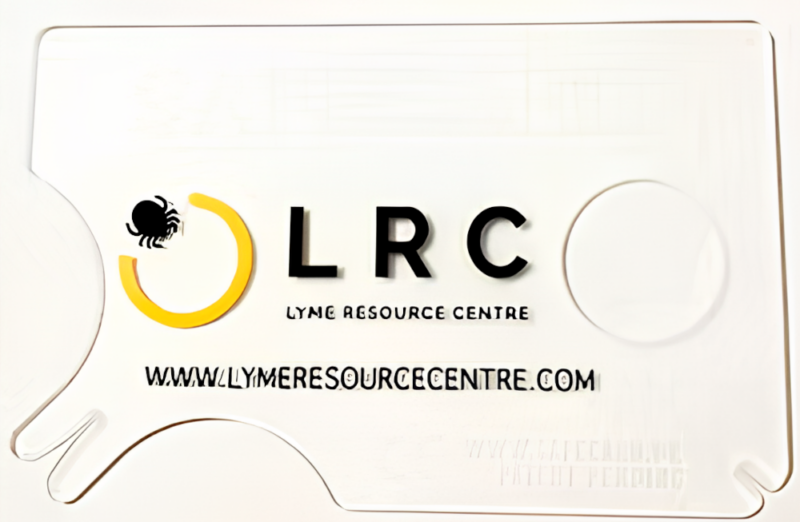
- Carry a recognised tick removal tool at all times – typically a tick twister or remover card
Organised walk leaders can play a crucial role in keeping expeditions safe, enjoyable, and enriching by providing advance advice on tick bite prevention.
Removing an Attached Tick
Ticks should be removed promptly and carefully. There is no proven minimum time of transmission of infection from an infected tick bite, though the longer the attachment the greater the risk. Squashing or traumatising an attached tick increases the risk of transmission of infection, so removing the tick the correct way is important. If you are bitten by a tick:
- It may be helpful to take a photograph of the tick in situ, should you develop Lyme disease and want to show your health professional that you have had a bite and have a date for bite
- Use a recognised tick removal tool and follow its instructions
- tick twister – small or large size tool depending on size of tick – gently slide the hooked part under the body of the tick with the open end of the ‘V’ towards the head; quickly but gently twist the tool 2-3x and lift upwards to cleanly remove the tick
- card remover – slide the corner of the card (small or large corner shape, depending on size of tick) under the body of the tick, with the open end towards the head of the tick. Once fully under the tick, lift the card parallel to the skin to lift out the tick. Card removers may also have a small magnifying area to help view the tick before removal.
- Do not try to remove the tick in other ways (e.g. alcohol, oil, nail varnish)
- After removing the tick, wash the site of the bite with soap and water or antiseptic
A small (less than 2cm) localised area of redness may occur at the bite area shortly after a tick bite, but usually resolves in 3-5 days and is probably not an indication of Lyme disease.
After a Tick Bite
After a tick is removed, it’s important to watch for the first signs of Lyme disease; if these signs present, its crucial to get attention from a health professional at the earliest opportunity. Early diagnosis and prompt, correct treatment of Lyme disease offers the best chance of cure.
The early signs of Lyme disease are usually a rash called Erythema migrans (EM) and a flu-like illness. Erythema migrans is diagnostic for Lyme disease – no blood test is required and antibiotics should be started immediately.
If Lyme disease is diagnosed, it is a serious bacterial infection requiring 3 weeks of relatively high dose antibiotics.
If you do get a tick bite, it is important to monitor skin for a rash – key observations about EM rash are show in the table and the hallmark ‘bull’s eye’ EM rash in the picture. Consider not just the appearance of the rash at the point it presents, but its behaviour over time. It can be helpful to photograph the rash at various stages or draw a line around it to monitor change in size.
Not all health professionals are fully aware of the nuances of Lyme disease, so it can be helpful to point them towards NICE guideline 95 – Lyme disease, which provides guidance on diagnosis and treatment and / or the RCGP Lyme disease toolkit, both providing recognised, evidence-based information on Lyme disease.

What to look out for with possible Lyme disease rash:
- Usually develops within 3-30 days of a tick bite, can be up to 3 months
- May be absent or go unnoticed in at least 30% of cases
- Typically, an expanding confluent red rash, not necessarily ‘bull’s eye’
- Usually painless, not itchy and greater than 5 cm in diameter
- May be red / blue / purplish in colour and difficult to identify on pigmented skin
- Usually appears at bite site, but not always; there can be multiple rashes
- May become more obvious after a bath or shower
- May disappear spontaneously – antibiotics are still required
- May be misdiagnosed as another insect bite, ringworm or cellulitis
For more information the Lyme Resource Centre has developed a range of clear, accessible resources to support safe walk planning.