
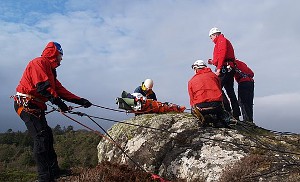
Hebrides Search and Rescue Team training
The study was undertaken in Wales by Julia Kramer who believes the results are likely to be similar for other areas of the UK.
She said: “Ambulances can’t get up mountains, and air ambulances can’t land on steep ground, but ambulance services are sometimes asked to attend inaccessible locations which require a hoist-equipped helicopter or mountain rescue team.”
She said: “Remember: if you need help in the mountains dial 999 or 112 and ask for police then mountain rescue.”
The Mountaineering Council of Scotland’s Mountain Safety Advisor Heather Morning said that many people did appear unsure of what they should do in the event of an accident.
“It can be very unnerving to witness an accident, even for experienced mountaineers, and making sound judgments when in a state of shock is not easy, so it is a good idea if climbers and walkers both have a prepared set of actions. You can even prepare a list to keep in your First Aid kit.”
Heather recommends the following actions if you are caught up in an emergency in the hills.
First step, always, is to ensure your own safety and that of the rest of your party, attend to airway, breathing and circulation of the casualty. Make a quick assessment of injuries and treat as necessary.
Provide shelter and comfort for casualty and group, identify location and mark it with bivvy bag/ group shelter or similar. Decide whether you can deal with the situation yourself, or require outside assistance. If in doubt, always be cautious and call the emergency services.
Write down the position of the accident site including grid reference, injuries, time of accident and weather. Also note down telephone numbers of other members in the group. If necessary, dial 999 (or 112 – both work equally well) and ask for ‘Police – Mountain Rescue’ if you are on the hill.
The Police will need the following information as a minimum:
The location of the incident (a six figure grid reference and a named feature)
The number of casualties
What is wrong with the casualties
Are the casualties deteriorating
Details of the equipment you and the casualties have with you
Your contact telephone number
Heather says, “Mobile phones have made summoning help easier than ever before, but people should be aware of their limitations in mountain areas where there may not be a signal. It may be necessary to send someone (preferably two for safety) to a location where a phone signal is available. Remember, too, the international distress signals of six blasts on a whistle (or six flashes of light) repeated at one-minute intervals.”