
Summary
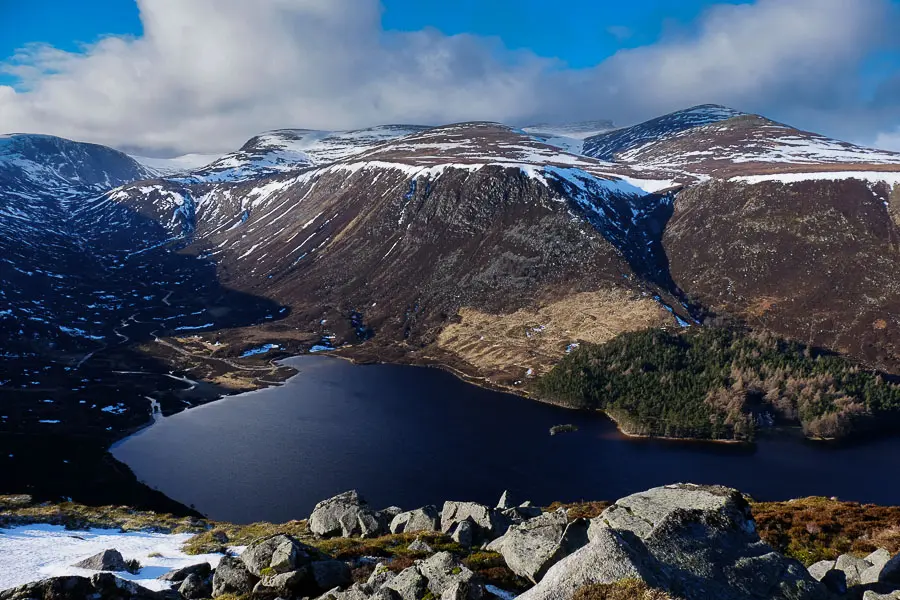
A long hillwalk taking in the five Munros on the extensive White Mounth plateau. Lochnagar is by far the finest of the summits, but in good weather this is all a hugely enjoyable round with a great feeling of space.
Grade

Bog Factor

Rating
Distance
Time
(in summer)
Ascent
Terrain
A long and exposed mountain route; in good conditions the stony, tundra-like terrain makes for easy going.
Are you REALLY ready for winter hills?
Hillwalking when there is snow lying requires an ice-axe, crampons and knowledge of how to use them safely. The description here is for summer conditions.
See our Winter Skills page for basic information on the essential skills, techniques and knowledge needed for winter.
Getting there
Start
Car park at Spittal of Glen Muick (charge).
Public Transport
None to start.
Start Grid Ref
NO309851
Summits Climbed
- Munro
- Lochnagar
- Munro
- Càrn a' Choire Bhòidheach
- Munro
- Càrn an t-Sagairt Mòr
- Munro
- Cairn Bannoch
- Munro
- Broad Cairn

Stage 1
Park at the either of the large car parks at the end of the public road up Glen Muick. Continue along the track to the Spittal of Glen Muick, where there is a small wooden visitor centre and public toilets. Lochnagar is the first peak on this route, so turn up the track to the right here. Follow this across the flat floor of the glen, soon crossing a bridge over the River Muick. At the far side of the glen, fork left onto a path that then meets another track at forestry surrounding the Balmoral Estate's various buildings at Allt-na-guibhsaich. Go straight across on a path up through the woods to gain the track which ascends beside the stream. After just under 1km of uphill the track crosses to the north side of the Allt na Guibhsaich; this is usually easily crossed.

Stage 2
Pass above the minor gorge of Clais Rathadan and follow the track round to the right. Further on, take the clear branch path leading off to the left - this is the main path for Lochnagar, and has been improved in recent years by stone-pitching. Follow the path as it climbs towards the bealach or col visible between the main bulk of Lochnagar on the left, and its outlying peak of Meikle Pap. The path passes a memorial to Bill Stuart, a climber who was killed on the cliffs in 1953. As you approach the bealach, the main Lochnagar path diverts off to the left, but it is really worth continuing ahead to the bealach itself.

Stage 3
Here, the massive but domed and stony hills of the walk so far are replaced by a view across Lochnagar's famous northern corrie, a magnificent curve of buttresses cradling a small lochan. If you have the energy, you can divert up to the summit of Meikle Pap on the right for the best views. Rejoin the path for the ascent up the slope on the left, known as the Ladder. This slope is covered with large boulders but the path avoids the worst; in winter this slope is notorious for avalanches. Above the Ladder the slope eases onto a flatter plateau. Follow the edge of the cliffs (not too closely!) round to the right; in good weather you can peer down the gullies to the lochan below.

Stage 4
As the cliffs curve to the northwest, there is another ascent, and the minor cairn on a boulder at Cac Càrn Mòr is just beyond. Continue to reach the viewpoint indicator on the pointed rocky outcrop at Cac Càrn Beag, the true summit of Lochnagar, which a magnificent viewpoint for Deeside and the Cairngorms massif. Lochnagar was climbed by Queen Victoria, who wrote of the summit 'But alas! Nothing whatever to be seen; and it was cold, and wet, and cheerless.' Hopefully you are luckier!

Stage 5
Return to the Cac Càrn Mòr but this time follow the path which heads southwest across the plateau. Across a shallow bealach, the path ascends towards the rocky prow of The Stuic, which is worth detouring to for its view down to Loch nan Eun and across the Dee valley. Although The Stuic is the finest prominence on this part of the walk, the Munro summit of the White Mounth is Càrn a'Choire Bhòidheach, which is reached by a detour of about half a kilometre to the south. A local legend says that when all the snows here melt, the day of doom is drawing near - these days the snows melt every summer so perhaps Global warming has been more dramatic than previously thought! Head northwest to regain the old stalkers path, turning left onto it as it descends across the flank of the hill and crosses the Allt an Da Chraobh Bheath.

Stage 6
The domed hill to the north here is Càrn an t-Sagairt Beag, a humble top; to reach the next Munro, continue on the stalkers path until after it crosses a second stream, and then strike northwest uphill as soon as the going is straightforward. This brings you to the cairns on the summit of Càrn an t-Sagairt Mòr , Munro no.3 at 1047 metres; there are two cairns, with the more southerly being the higher. Just to the north is a large piece of wreckage - a part of an RAF Canberra aircraft which crashed into the hillside here in 1956. There are further fragments of wreckage spread over a wide area of the mountain.

Stage 7
Descend southeast from the cairn to the wide, featureless bealach. This is truly bleak country, and navigation could be difficult in bad weather; the summit of Munro no.4, Cairn Bannoch at 1012 metres, is easier to spot in better conditions, with its cairn atop an outcrop, itself topping a small conical peak. Continue southeast, bypassing Cairn of Gowal, to gain an ever improving path to the final Munro, Broad Cairn. This summit can be avoided on its south side by a stalkers path, but today's bagging generation of walkers have blazed a new path over the summit cairn. This is a better viewpoint, with Loch Muick in view, whilst to the northwest the plateau collapses in the great precipices of Creag an Dubh Loch - a crag which in recent times has approached the popularity of Lochnagar itself.

Stage 8
Continue east from the summit, descending a boulderfield to join a bulldozed track across the plateau. Follow this as it curves southeast before it curves back left to come close to the edge of the steep slopes above Loch Muick. The track runs across the top of these slopes for some distance, giving excellent views of the Loch, before it reaches the end of the plateau and descends in a series of zigzags. Cross the bridge over the Black Burn and continue on the track which still keeps some height above Loch Muick. Pass close to the boathouse near the foot of the loch, and continue straight ahead on the track to return to the Spittal of Glenmuick.

Route Profile
