
Summary
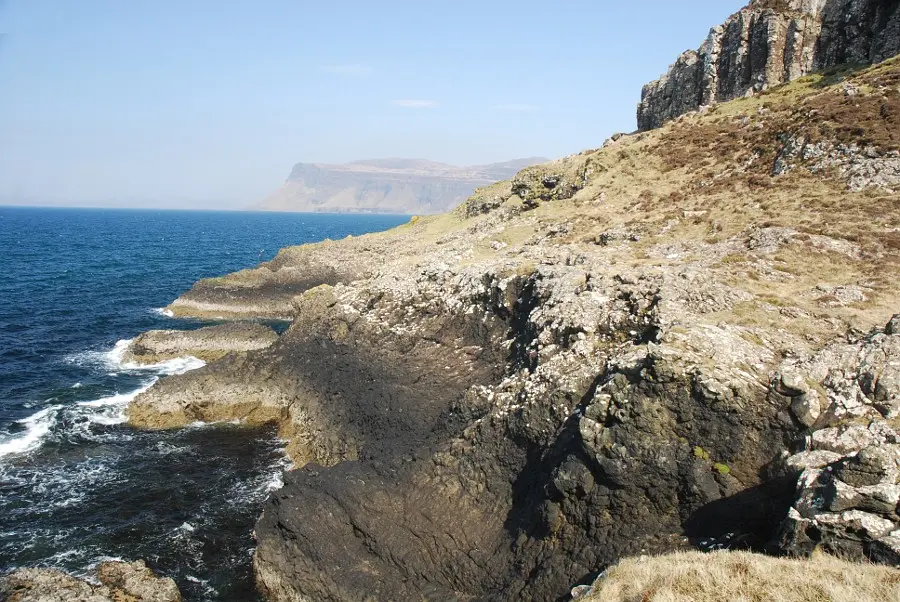
This short but rough and pathless walk visits some attractive wild coastline with views across to the Ardmeanach Peninsula. The objective is a visit to a gully of geological interest; narrow bands of fossilised leaf mould have been found in the side walls.


Terrain
Pathless moorland and coastline; very boggy in parts.
Getting there
Start
Near the road end at Eorabus.
Public Transport
None; could walk from Bunessan.
Start Grid Ref
NM380237

Stage 1
From Bunessan take the road signed for Ardtun on the east side of the village. Keep following the road along the water until a fork where you turn left. Just before reaching the last two houses there is limited parking for one car only on a bend in the road just beyond a stream at a farm gate. Take care not to block the gate or road. Start the walk by going through the gate and keep straight, on heading for the pimple ahead which is Dunan Mòr .

Stage 2
Dunan Mòr is a small rocky outcrop with a prominent cairn, it is a good viewpoint over the coast. From here continue in the same direction across boggy ground to reach a point where you can head down a grassy and stony ramp to reach the bottom of the cliffs. Bear right along this wide coastal strip which has some ruined dwellings. The fluted basalt columns in the cliffs can be seen well from here, and on a clear day Staffa can be seen out at sea. Eventually the way is barred by a rope fence.

Stage 3
Beyond this is a deep inlet with steep sides which is impossible to pass. Instead head back slightly to pick up a steep path heading diagonally up the cliffs to reach the top. Head around the top of the cliffs with good views to the massive cliffs of Ardmeanach across the water. Soon you are forced inland by a gully which is well above the sea and covered with fallen rocks lower down. Follow the faint path down it from the top to reach a flat area where fossilised leaf beds can be seen.

Stage 4
These narrow bands of fossilised leaf mould are composed of the leaves of trees growing here in prehistoric times and were formed after the leaves fell into a lake year after year and built up between layers of mud and sand to become rock. They were discovered by the Duke of Argyll in 1851. Many of the leaf beds have been scraped away by fossil hunters and can be seen as grooves in the rock. On the right hand side as you look out to sea there is a long leaf bed above which someone has carved 'Fossilised Tree'. Fossils can sometimes be found on the gully floor which show the pattern of leaf veins from leaves growing here about 54 million years ago - a similar date to the famous fossil tree on Ardmeanach. Climb back up the gully and follow a faint path back along the top of the cliffs and then aim for Dunan Mòr to retrace your steps to the gate at the start.

Route Profile
