

Have you noticed stripey patterns on high hillsides? I’ve noticed a lot recently. That’s undoubtedly because I’m spending so much time in the Cairngorms these days, where such patterns are common, but you’ll see them on many big hills across the country.
I’m specifically thinking of bands of vegetation, interspersed with strips of rock or bare ground, which together form a sequence that paints a stripey pattern across a hillside.
Some of these sequences are found on flat ground, while others are aligned with the contours on gently sloping ground. The latter can have the appearance of steps or terraces, but the most dramatic patterns sweep diagonally and improbably down steep hillsides, looking like ripples or waves.
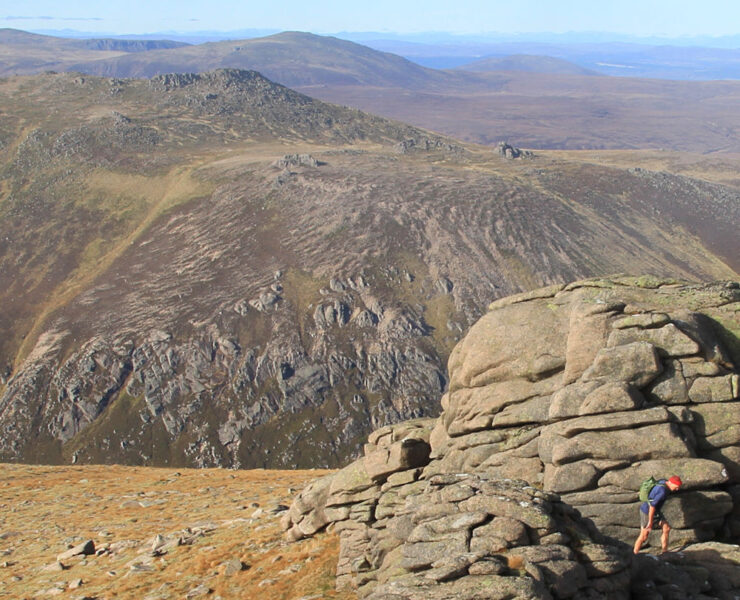
Such patterns have always drawn my eye for photos – their weird regularity of form offering a striking contrast with the natural undulations and curves of a post-glacial landscape. But while I’ve seen them many times before, I can’t say I’d thought much about their origins till now.
I went into investigation mode to learn more about them, naively assuming that all these features would have a common explanation. But it quickly became apparent that there are loads of different stripey features, all very different, and each with their own origin stories and behaviours. Too many to write comprehensively about here.
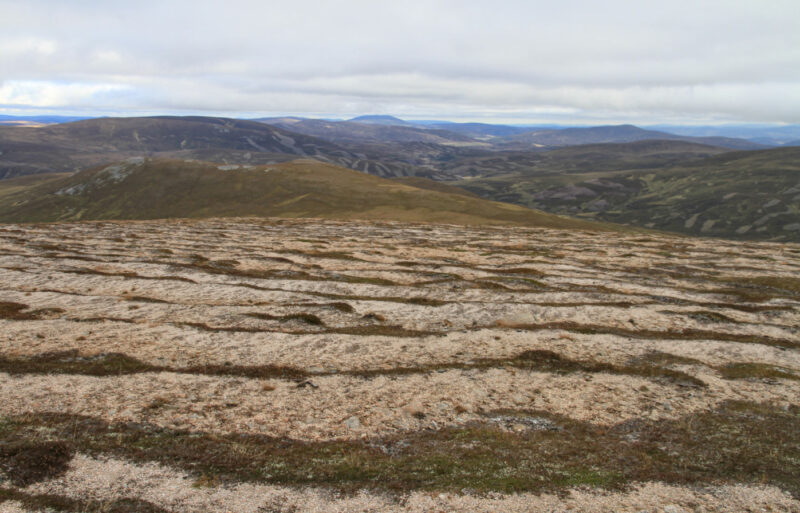
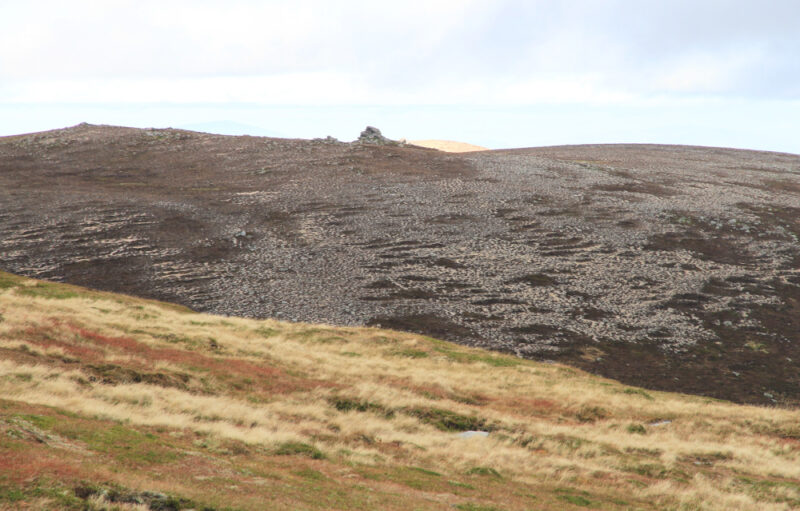
But the pattern I was most keen to understand, was the one I keep seeing repeated across flat, high ground in the Cairngorms. Typically on exposed flanks and ridges above 700m altitude – a brown and white alternation between bare gravelly ground and slightly-raised strips of heather. The stripes are parallel, each about one metre wide, and while most are just a few metres long, some are apparently as much as 40m in length.
Each sequence of stripes covers ground for a considerable distance, and while in some places I’ve seen long stripes of equal length, occurring at regular intervals like striped curtains, more often than not it tends to be a looser patchwork of shorter (but still parallel) stripes, arranged similar distances apart from one another. Walking through them at close quarters, the appearance underfoot is one of regular stripes, but seen from above they look more like the stripey patterns on a tiger’s coat.
Because they’re found on flatter ground, I don’t usually clock them until I’m literally walking across them, at which point the regular spacing of ‘brown and white’ underfoot leaps out at me because it’s like the landscape is strobing!
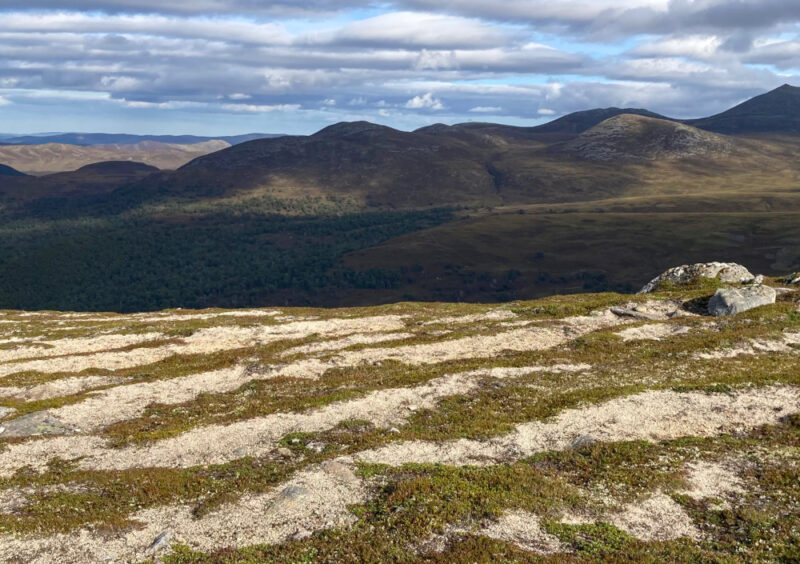
Most of the ones I’ve encountered this year, on Ben Avon, Beinn a’ Bhuird and Creag nan Leachda in particular, have been formed by stripes of heather. This is why you’ll see reference online to ‘heather stripes’, but they can also be formed by other woody heath species, such as crowberry. For this reason, you’ll also find them referred to as ‘vegetation stripes’.
Their consistency of form, and the regularity of their spacing across a landscape, means the sequences of stripes are often described in terms of ‘wavelength’ and ‘amplitude’. Heather stripe wavelength, i.e. the distance between two ‘waves’ of heather, can vary from one sequence to another, but wavelengths in any given sequence have been found to be consistent. A study undertaken across four years in the 1970s, at 12 locations across the Cairngorms, found wavelengths between 85cm and 138cm.
Amplitude, i.e. the height difference between the ‘crest’ of the heather waves and the bare ‘troughs’ in between, is similarly consistent across a sequence. The same study found amplitudes of between 5.1cm and 9.7cm across the 12 sites. Not exactly mountains, I know. The bigger ones are barely even steps! As I say, these are slightly-raised features rather than things you need to step onto or over.
The comparison with waves is fitting though, because if you stripped the heather away to reveal the form of the ground underneath, each wave would have the same broad shape when viewed as a cross-section – namely a convex (bulging outwards) surface on one side, and a concave surface (bulging inwards) on the other. Just like an ocean wave approaching a beach, before it starts to break.
Why this form though?
Why the vegetated strip?
Why the bare ground?
So many questions!!
Consensus online is that these stripes form most readily where heather is at its altitudinal limit. Wind is therefore key, hence this particular kind of feature more often described as ‘wind stripes’.
Soil and rock particles, scoured from the landscape, are blown by the prevailing wind into the heather, which catches the particles in its canopy. Further downwind, beyond the heather, there is no shelter and any soil is blown away.
The heather, as an obstacle, helps the windblown particles to accumulate on the ground to a greater depth than they otherwise be able to do, which means an underlying, raised ‘wave’ of soil forms. On the leeward, sheltered side you get a concave surface where grains naturally slip down the accumulation, towards the trough.
On the upwind side of the heather, life is especially harsh. The wind dries the heather out, freezes it, but also pelts it with airborne rock sediment and ice, which is thought to cause abrasion. The heather is therefore constantly dying and eroding on the windward side.
Amazingly though, even across the miniscule difference in height between the wave crest and the wave trough, the windspeeds in the more sheltered part of the trough can apparently be half those of the crest. There is, therefore, an inhospitable and exposed side of the wave, and a hospitable and sheltered side. It has to be said, though, that in the Cairngorms, ‘hospitable’ is a relative term! Life in the trough certainly isn’t a walk in the park, but it’s on this more sheltered, concave side of the wave that you will find most of the heather growing, because this is really the only place it can actually put out any growth.
It might seem improbable that anything could take root in as windy an environment as this, but heather is particularly well-suited to this kind of barely perceptible, prostrate growth close to the ground. It’s able to put out ‘adventitious’ roots (called layering), without seeds, which allows it a certain amount of outward growth each year.
Heather can and does set seed, but it’s difficult under these conditions. In the 1970s study, heather seedlings were found in the bare stripes downwind of the heather, but none of the ones that established more than 15cm away from the wave crest survived more than 10 months. The exposure was too severe. The bare ground in front and behind the heather stripe is therefore maintained, as conditions are too severe both upwind and down.
Now, if at this point you are picturing this wind-blasted heather dying on one side of the stripe and growing on the other, you might be tentatively thinking to yourself……”but……doesn’t that mean that the heather stripe must be……erm……moving?”
YES!
Heather stripes aren’t static features in the landscape. They move, as do the stripes of bare ground. You can sometimes see old, raggedy heather roots immediately upwind of the stripe, trailing behind as the whole heathery carpet moves downwind in its perpetual search for shelter.
Over time, the trough in front of heather stripe becomes the wave crest as the heather inches forwards, collecting and depositing those finer windblown soil materials as it goes. In the heather stripe’s wake is increasingly bare ground, scoured clean by the winds. There appears to be a balance as it moves, with studies indicating that the width of stripes is largely stable over time.
I’m in awe of the folk who discovered this movement. I mean, to go out and measure things that barely move, in such remote and challenging environments, is dedication to be sure.
Look no further than N G Bayfield, of the (then) Institute of Terrestrial Ecology in Banchory, who undertook the study between 1975 and 1979. He doesn’t mention anyone else in the study so I’m assuming he probably did it all by himself?!
He whacked posts into the ground in the middle of the heather stripes, in sequences of 10 to 25 stripes, so that the tops of the post were flush with the ground. He then measured the distance from the post to either edge of the stripe, and repeated the measurements at later dates.
Across the 12 sites in the Cairngorms, Bayfield found that different sequences of stripes advanced at different speeds. On Mount Keen, they were racing across the hillside at……wait for it…..25mm per year! Clearly you won’t be needing high shutter speeds to capture Mount Keen’s stripes in motion, but 25mm is fast for a wind stripe. Taking all 12 sites into consideration, Bayfield clocked stripes moving at an average of 9mm per year. And while they moved in the same direction as the prevailing wind, he found that they could move downslope, across slope or even upslope.
He also suggested that stripe movement could change with the weather. For instance, the stripes moved more slowly in 1976, which was the famously dry and hot year, and moved more quickly in the other, wetter years. Moisture appeared to offer better conditions for growth, and one therefore wonders what this might mean for long term survival of heather stripes, if we experience more prolonged periods of drought?
In any event, it would be revealing to have time lapse photography of a whole hillside over many years. 100 years wouldn’t be enough, as the stripes would have only moved a metre or so over that time. But 1000 years maybe? 10,000? Presumably we would we see parallel stripes rippling across the hillside like waves.
But if this all explains how stripes maintain their shape, formation and movement, it doesn’t explain where they came from, or how they started?
Well, while there’s consensus on the physical characteristics and movement of heather stripes, there’s less certainty about where they came from. I was surprised to find uncertainty in a subject with many decades of interest, but at the same time I found the debate and uncertainty oddly satisfying. It’s nice that there are some things happening that we can’t fully explain.
The main question in the 20th Century studies seemed to be asking, do stripe sequences start life as bare ground or as vegetated ground? i.e. are stripes a result of vegetation moving in, or moving out?
On the ‘moving-in’ side of the debate, it’s suggested that ripples of soil form on bare surfaces through the action of wind – such as in sand dunes. Might the same have happened in the Cairngorms, and then heather colonised the sheltered leeward side of those ripples? Then, as the heather took hold, it essentially replicated this underlying topography?
My sense though, is that modern studies prefer the ‘moving out’ theory, i.e. of blanket vegetation cover being broken up by environmental factors. An early theory was that stripes might have broken free from the edges of much larger patches of vegetation, thus embarking on lonely journeys across bare hillsides. I have to say, I love the idea of rogue strips of heather setting off into the vast unknown, roaming free with the wind in their sails. It paints a picture of a very dynamic landscape, with its composite features constantly on the move. But the theory these days is of a carpet of intact heather, within which stripes of bare ground somehow form.
This could happen due to wind, frost heave, or presumably animals, but once a small patch of vegetation has been removed, it can erode at the edges and further expand through a process called ‘deflation’ (the removal of loose material), and so create ‘deflation scars’ – strips of bare ground several metres long and about a metre wide, within the heather. How these then orientate themselves into parallel stripes still seems to be something of a mystery, and it’s not something I was able to find answers to online.
I also can’t help wonder……. assuming that stripes did indeed form from the erosion of blanket vegetation cover under severe environmental conditions, how did blanket vegetation cover develop up there in the first place? Well, the hypothesis seems to be that yes, the heather was indeed able to grow in the first place, but it was knocked back by a prolonged (and surprisingly recent) period of more severe weather.
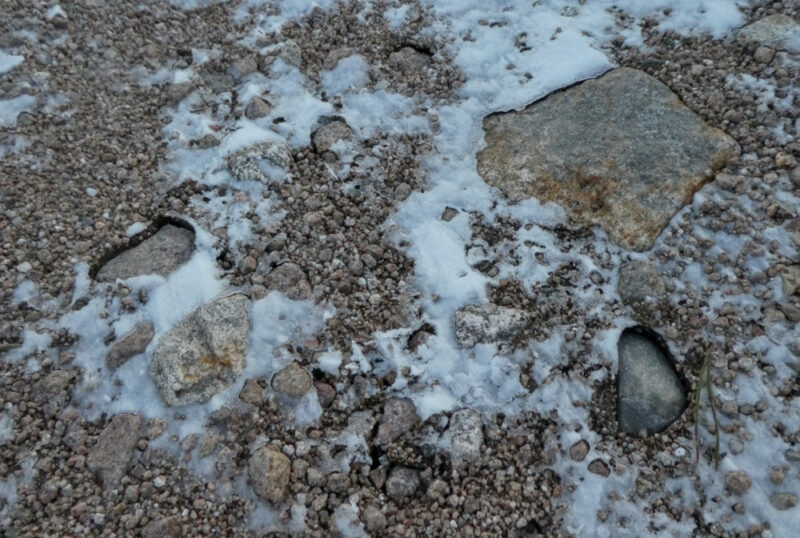
Colin Ballantyne, a prominent and prolific geologist at University of St Andrews, refers to wind stripes as having been established in the Little Ice Age – a colder, snowier and windier time between the 16th and 19th centuries when vegetation was damaged or stripped from many high places. That being the case, it suggests that the wind stripes I’ve been encountering have origins within the timescale of centuries, rather than millennia.
Given there are still some known unknowns where heather stripes are concerned, research still continues to this day. The most recent (2025) study I could find, by Toyo Vignal, from the Okinawa Institute of Science and Technology, set out to find a mathematical model to explain the formation of wind stripes in Scotland. In the course of successfully modelling the many variables, and conforming that wind was indeed a key driver of their formation, her study found that flat ground could give rise to the stripes once the wind goes beyond a ‘critical speed’.
However, the modelling also showed that if the wind is too strong then all vegetation could be completely stripped away. The underlying soil ripples would then smooth out as environmental conditions (frost and wind) dispersed them across the wider landscape.
Conversely, if the prevailing wind becomes much less severe, and conditions on the bare soil become more hospitable to vegetation growth, then the bare patches between stripes would in-fill with new heather and the stripes would eventually disappear. This research (erm….if I’ve understood it correctly of course!) implies there is a sweet spot, within which stripe formation both occurs and is maintained.
However, even here, the author is careful to point out that while this proves that heather, wind and soil can spontaneously give rise to regular stripes in the landscape, that’s not to say that wind is the primary cause or that other factors aren’t contributing too.
The reason for the caveat is that things change depending on where on the hillside you are and what the weather is doing. Vignal anticipates that adding other variables such as wind coming from multiple directions, changes in slope, or other wind obstacles such as boulders and rocks, would likely allow her to model the other patterns you see on Scottish hillsides – namely the more fragmented ‘tiger’ stripes I’ve been encountering. This is something the 1970s study highlighted too, that the more regular or uniform stripes were a feature of flatter ground where there are fewer bumps, lumps and obstacles, whereas fragmented patterns were a result of the wind being broken into eddies and currents by such obstructions. There’s certainly no shortage of rocks and boulders in the Cairngorms.
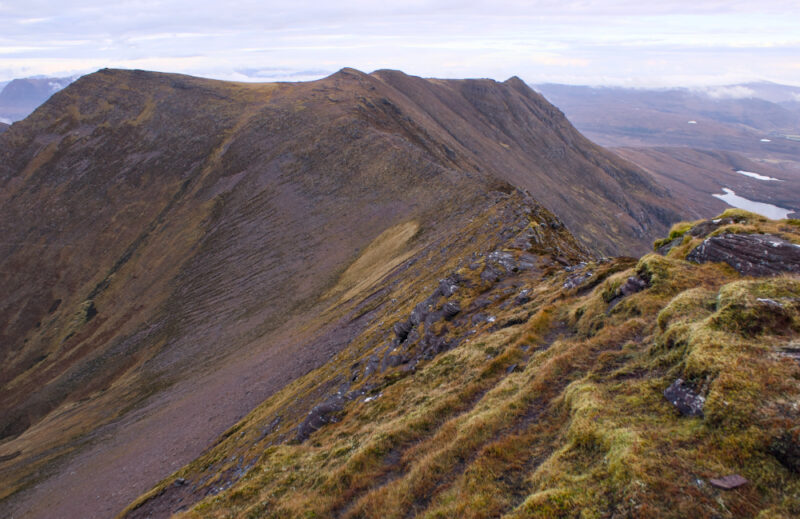
But once you get onto more sloping ground, other things such as gravity, frost heave and the movement of water come into play to a greater extent, and the mechanics of stripe formation can be very different. The physical appearance and dimensions change significantly, and you start to see more of the steps and ‘terraces’ variety of landform (illustrated by some of the other photos in this piece), which are in themselves an article for another day.
In the meantime though, keep an eye out when you’re walking the hills, because there’s a very good chance you will encounter many of these stripey features yourself. And when you do, allow yourself to ponder that wonderful imponderable that’s so hard for us, a short-lived species, to get our tiny heads around: the landscape we walk through is not preserved in aspic. It’s not a finished sculpture. Instead, it is constantly eroding, constantly changing and constantly on the move……even if it’s not in a hurry to get there!