
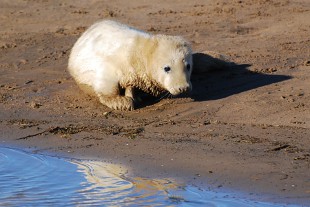
Seal pup at Tentsmuir
Grey seal pups are born from the end of this month (September) until mid-December.
The main concentrations are in Orkney, south-east Scotland and the Inner and Outer Hebrides with smaller colonies in Shetland, and along the north and north-east coasts of Scotland in particular.
The young can’t immediately venture into the sea after birth, but stay on the foreshore for up to 30 days while their mother feeds them to build up their body fat and strength.
Any disturbance stresses the pup and mother, and the youngster may also move away from where the mother has left it. If approached, the adults may become alarmed and stampede towards the sea, resulting in pups being crushed or injured.
Tom Cunningham, Tentsmuir national nature reserve manager, said: “We already have a few seal pups at Tentsmuir and people are understandably fascinated by them. But we’d ask people to keep themselves and their dogs a good distance away and never touch a seal pup. Even if a seal pup appears to be on its own, the mother may be close by and may abandon her pup if it sees people nearby.”
Therese Alampo, St Cyrus national nature reserve manager, added: “We occasionally have seal pups left by their mums on the beach, so folk think they are abandoned and try to get close – or even stroke – the pups. The best advice is to leave them alone and enjoy a look from well back. We’d appreciate too if people could pop in the reserve office and let us know if they see seal pups.”
Grey seals are found only in the north Atlantic, the Baltic Sea and the Barents Sea. They are one of the rarer seal species with a world population of only 350,000-400,000. Around 36% of the world population lives in the UK, and around 90% of these live in Scotland. Walks where you are likely to be able to see grey seals and pups from a safe distance include Tentsmuir and St Cyrus.