
Summary
With a start at over 400 metres, Stuchd an Lochain gives a short ascent for a Munro. The initial climb is steep and boggy but the ridge traverse that follows around above the corrie cradling little Lochan nan Cat, is a delight, and the summit views are superb.
Grade

Bog Factor

Rating
Distance
Time
(in summer)
Ascent
Terrain
Steep, wet and eroded ascent to the ridge. Once on the ridge there is a line of fenceposts and path leading more easily to the summit.
Are you REALLY ready for winter hills?
Hillwalking when there is snow lying requires an ice-axe, crampons and knowledge of how to use them safely. The description here is for summer conditions.
See our Winter Skills page for basic information on the essential skills, techniques and knowledge needed for winter.
Getting there
Start
Below Giorra Dam, Loch an Dàmh.
Public Transport
None to start.
Start Grid Ref
NN511463
Summits Climbed
- Munro
- Stuchd an Lochain

Stage 1
Take the minor road that branches off Glen Lyon to head up to the Giorra Dam of Loch an Dàimh (which means the Loch of the Stag, not of the Dam!). There is parking just before the bridge over the river below the dam. Begin the walk by crossing the bridge and following the track which climbs up to the south end of the dam. The dam was built and the present loch created in the early 1960s as part of the Breadalbane hydroelectric scheme.

Stage 2
A couple of hundred metres further along the track is a cairn marking the start of the path up Stuchd an Lochain. This climbs across the slope for some distance until almost directly above the boathouse on the shores of the reservoir.

Stage 3
The path continues very steeply up towards the ridge and is wet and eroded in places. The recompense is in the improving views back down over the dam. Continue the ascent to the south-southwest until the broad east ridge of Creag an Fheadain is reached.

Stage 4
Turn right and follow the now much drier hill path. There is a short steeper section before the flat top of Creag an Fheadain, which has a couple of cairns. The summit of Stuchd an Lochain now comes into view for the first time, with Loch an Dàimh seen to its right. The ridge now leads SSW and descends to a slight bealach before climbing once more, this time to the Top of Sròn a'Chona Choirein.

Stage 5
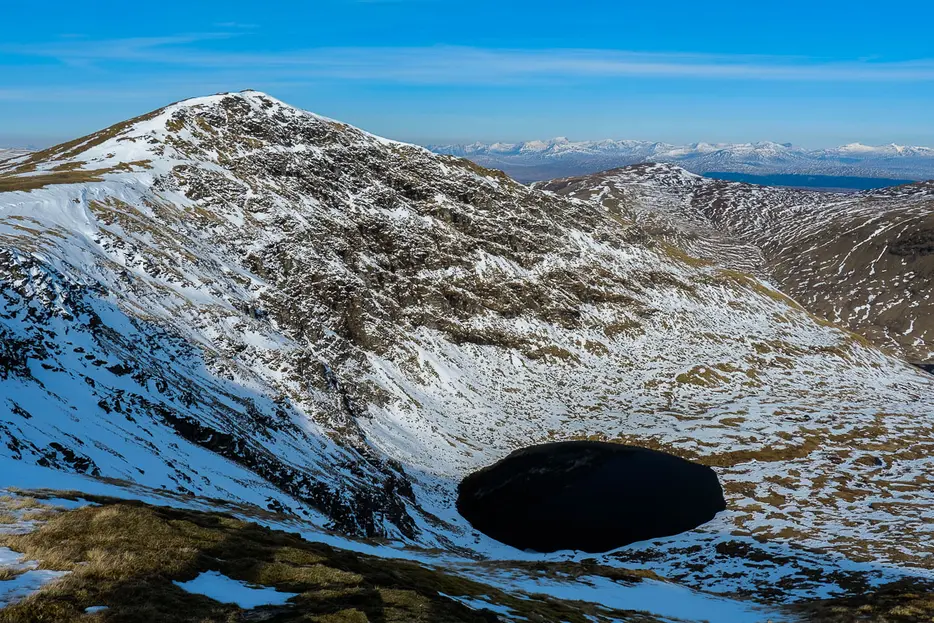
Continue west across the almost flat plateau. From the rim of the cliffs of Coire an Lochain Stuchd an Lochain looks its very finest, rising drmatically from the attractive and almost circular Lochan nan Cat. After a slight descent the final climb towards the summit begins. The fenceposts go left just before the summit cairn, which is close to the edge of the crags.

Stage 6
Although it may be a relatively modest hill in terms of the giants of the area, the mountain has a strategic position and the view is very extensive. Ben Lawers dominates to the southeast, but the finest outlook is from a few paces beyond the cairn to bring into view the head of Loch an Dàimh, with Rannoch Moor and then - if the day is clear - the peaks of Glen Coe and Ben Nevis beyond.

Stage 7
The most straightforward route of return is to retrace your steps; descents to the reservoir are not recommended as the shore gives very hard going. Once back at the start, many Munro baggers will be keen to ascend Meall Buidhe on the same day from the other side of the dam.

Route Profile
