
Summary
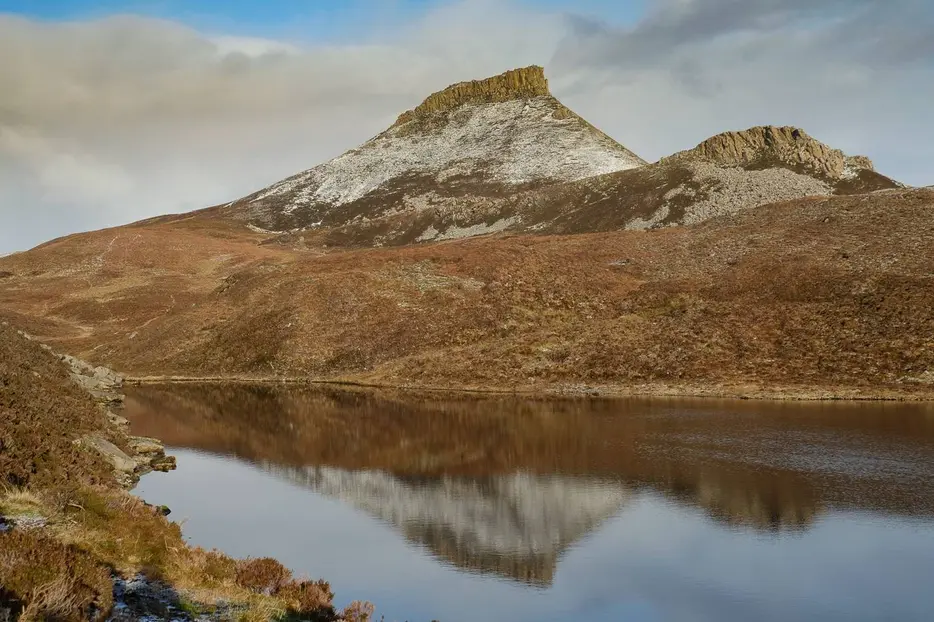
The distinctive flat-topped summit of Dùn Caan (Dùn Cana in Gaelic) is the highest hill on the Isle of Raasay and a sensational viewpoint. Standing at the top, surrounded by endless views of mountain and sea, one can sympathise with James Boswell who is said to have danced a jig when he visited the summit during his famous tour of the Highlands and Islands with Samuel Johnson.
Grade

Bog Factor

Rating
Distance
Time
(in summer)
Ascent
Terrain
There is a path for the whole route, though the approach to Dùn Caan is very boggy and indistinct in places. Some steep ground but no scrambling involved.
Are you REALLY ready for winter hills?
Hillwalking when there is snow lying requires an ice-axe, crampons and knowledge of how to use them safely. The description here is for summer conditions.
See our Winter Skills page for basic information on the essential skills, techniques and knowledge needed for winter.
Getting there
Start
Churchton Bay ferry terminal, Raasay.
Public Transport
Ferry to Raasay from Sconser on Skye; Sconser is served by bus.
Start Grid Ref
NG545362
Stage 1
The walk begins from the ferry terminal at Churchton Bay, where there is parking and public toilets. Bear right of the toilet building to follow the road along the bay. Take a tarmac lane off to the right, then when this forks almost immediately take the left branch signed as a dead end. Before the gate turn right onto a signed path, that soon swings left and climbs above a bungalow. Go through a kissing gate then bear right through the grassy field. The path keeps atop the bank that falls towards the coast, heading through two more kissing gates. When the modern Raasay Community Hall comes into view ahead bear right to reach a track, then turn left along this, passing the front of the hall and eventually rejoining the road. Bear right along the road towards Inverarish - the capital of Raasay.

Stage 2
When a junction is reached with a row of cottages ahead, turn left to head uphill through Inverarish. The cottages were originally built to house workers at the ironstone mines above. Pass the well-stocked community shop and continue to another road junction. This time turn briefly left (signed for the North Pole!), then take the next road on the right. Soon turn right into a parking area, signed as the site of the number 2 mine. After this mine was constructed geological faults were found which meant it was never worked. Bear right through the parking area, following the path signed as the Burma Road - a reference to its construction by forestry workers during the 1950's and the "jungle" of trees they encountered.. The path climbs through the trees, eventually emerging from them with more open views ahead.

Stage 3
Ignore a path off left (which is waymarked in white), instead keeping ahead and crossing several footbridges. When a signed path junction is reached just after one such bridge, turn left - signed for Dùn Cana. The path climbs through the trees with glimpses of a waterfall. Eventually it leads through a high gate in a deer fence to access the open moor. When the path approaches another fence stay on it as it bears right, ignoring the stile. For the next couple of kilometres the path is very boggy in places, and sometimes indistinct; it generally keeps just to the left of a burn. Looking back the views over the Cuillin on Skye become ever more impressive.

Stage 4
At one point the path passes a cairn and crosses a stile; there's a brief distant view of Dùn Caan's craggy summit. Continue on the path across the moor until Loch na Mna is reached, and Dùn Caan is seen once more at closer quarters. Ignore path uphill onto the escarpment, instead keeping to a lower path by the loch shore; this has been covered by fallen boulders near the end of the loch, which need to be clambered over.

Stage 5
Beyond the loch, keep below the escarpment; the path seems to peter out until it meets a clearer path coming in from the right. Keep ahead until a second loch, Loch na Meilich, is reached; this is the island water supply. Take the clear path which heads diagonally uphill to the right of the loch. Soon the path doubles back to the right, the first of a series of zig-zags up the steep slopes to Dùn Caan.

Stage 6
The upper slopes look very craggy, but the path up to it is excellent if closely followed and the flat, rock-strewn summit will soon be reached. The top is marked by a cylindrical trig point; although only 443 metres high Dùn Caan is a truly stunning viewpoint. The entire eastern coast of Skye can be seen, whilst in the opposite direction is a great sweep of the mainland from the Five Sisters of Kintail to Ruadh Reidh. Boswell climbed up to the top of Dùn Caan during his tour of the Hebrides with Johnson (who remained down in Raasay House, visited later on this walk); he was so delighted with the view that he danced a jig on the summit.

Stage 7
Return down the zig-zag path to Loch na Meilich. Instead of heading back towards Loch na Mna from here, cross the shingly ground by the loch and follow the clear path up the escarpment opposite. At the top of the escarpment, don't follow the branch path which heads along it to the left but instead keep to the main path straight on.

Stage 8
This path gives good going across the moor until emerging on a road after about two and a half kilometres. Turn left along the road, which has very little traffic. After an initial descent the road climbs up to a water works; another road heads off to the right after about another five hundred metres. Don't take this, instead keeping straight on for over a kilometre to where an unsurfaced track branches off right through a gate. Take this track.

Stage 9
The track ends at a wrought-iron kissing-gate. Go through this and follow the path beyond, which soon slopes down left to another road. There are wonderful views across to Skye from here. Turn left along the minor road, which soon enters a forest. Keep a look out for a Pictish symbol stone just off the road on the left. At a gate fork right onto a track that leads down to the extremely grand Raasay House. This was almost completely restored in 2009 before it was gutted by a devastating fire; it re-opened in 2013 after a second four year restoration. It houses an outdoor centre, accommodation and a cafe. In front of the house turn right onto a track that leads down to the ferry terminal; note the stone mermaids on the grassy mound - they were originally intended for the house entrance but now overlook all who arrive and leave the island.

Route Profile
