

One day last month at around 4pm, I spent about 10 minutes off-path, walking through heather. I got home half an hour later, flumped on the sofa with a bowl of twiglets, got the fire going, had dinner and then settled down for the evening. I was quite tired and fell asleep in front of the fire.
Around 11pm, just before bed, I felt an itch on my thigh. On closer inspection I found a tiny black dot in a small, itchy red circle. Ugh, a tick! I’d been working indoors the previous few days, so this was very likely to have come from my short walk through the heather.
I was instantly annoyed with myself, because I could easily have made the bite much less likely by following the advice that I readily dish out to anyone and everyone who seeks my advice about ticks. That being, when you get home you change out of your outdoor clothes immediately. Not after twiglets, not after dinner, not after curling up by the fire. BEFORE! Don’t faff or get distracted by other things because ticks can roam around your clothes for hours, long after you’ve come back indoors.
I fetched my tick-removal tool, still cursing but also consoling myself that it would at least have been detected by my last line of defence – the nightly tick check.
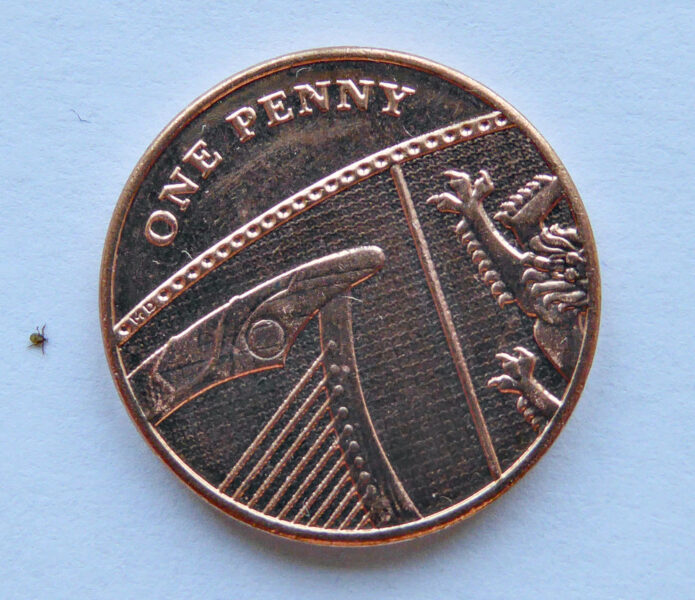
Smaller than you think?
This tick was very small and required several passes with the remover, but it eventually came out. I transferred it onto a piece of toilet roll so I could get a proper look against a white background. It was whole, happily crawling about. I then did what I always do – put some Sellotape over the tick, on the toilet paper, folded it up, wrote ‘Braemar, 18th May 2026’ on the paper, and popped it in the freezer.
I do this because when I had an unusual reaction to a tick bite back in 2009, and went to a GP in Edinburgh, my doctor refused to believe I’d been bitten by a tick, and took a lot of needless convincing otherwise. After that, I resolved I would keep subsequent ticks so that I could present a disbelieving GP with the culprit, location and date.
Job done, I got ready for bed, and then did my nightly check. Living in the Cairngorms, it’s a routine I religiously follow. I start with feet (including soles and between toes), legs, groin, arms, torso (including the ever-deepening recesses of my navel), and then back. It’s a little onerous when you just want to go to sleep, I admit, but it’s worth it.
So……feet, legs, gr…….oh, I’ve not had one THERE before! Yep, a second tick, where you REALLY don’t want a tick.
I finished the check and then, safe in the knowledge there wasn’t a third tick, repeated the removal and storage procedure.
It’s been a veeeery long time since I‘ve had to remove more than one tick in one day, and so I was doubly annoyed that my lapse in defence had been so unnecessary. The reason for the lapse, of course, was complacency.
The human brain struggles to maintain high-effort, low-reward tasks and I’m no exception. Studies abound about ‘vigilance decrement’ or ‘prevention fatigue’, where the maintenance of an inspection or defence regime can be adversely impacted by the repeated absence of a tangible threat or visible cue to action.
Clearly, in the days following a bite you’re going to be checking everywhere, every day. But as time goes on and you find nothing, you will likely be less thorough, and your defences will inevitably weaken. It’s natural human behaviour, requiring no small amount of will and discipline to overcome.
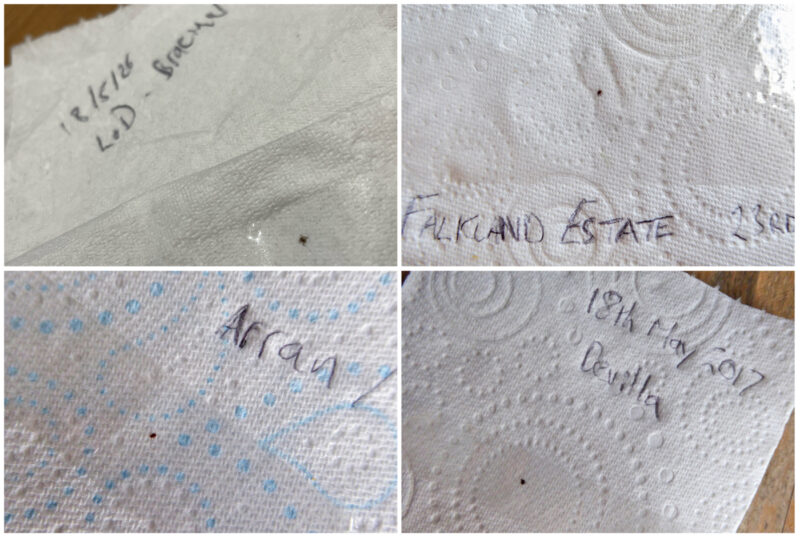
I do remain vigilant even through the winter, but I resume daily checks once the milder weather takes hold. Usually around March. And so this year, after a more normal winter where temperatures have remained suppressed well into spring, and after not finding ticks for more than 60 consecutive days, my brain had evidently downgraded the risk. Annoyingly, I appear to be someone who needs an occasional kick up the backside to remind me why I started doing something in the first place.
That’s not to say of course, that any one line of defence is 100% effective. But the more defences you have, the better.
Why though? What’s so bad about ticks?
Quite simply, it’s the infections that ticks can pass on to you. There are less well-known (but no less nasty) ones such as encephalitis, and the thankfully rare Alpha-gal syndrome (which results in an alarming and life-changing allergic reaction to mammal meat and dairy products). But better known, and more widespread, is Lyme Disease.
Lyme isn’t named after a person, rather it’s named after the Connecticut town of Lyme where the disease was first identified. It’s a bacterial infection that ticks generally acquire when they feed from an infected host. In Scotland those hosts are likely to be mice, voles, birds, deer etc, but it can then be passed from infected ticks to humans if the tick feeds on you afterwards.
It’s important to note however, that not all ticks carry the Borrelia bacteria that causes Lyme Disease. Surveys suggest that it’s found in about 5% of ticks in Scotland as a whole (just 1 in 20), but that percentage masks higher or lower rates depending on location. Prevalence of Lyme Disease within local tick populations does vary across the country, with a 2012 study finding it could be between 0.8% and 13.9%. So while the risk is fairly small, it nonetheless needs to be taken seriously.
Meet the tick
At this point, we should probably get to know the tick a little bit better. And yep, full disclosure, I have a healthy respect for ticks because they’re amazing creatures. Just imagine being able to expand to over 100 times your volume and weight without exploding. If we expanded by the same relative proportions as a tick after a full feed, we’d be the size of a house and weigh as much as an HGV!
There are around 900 species of tick in the world, fewer than 20 of which are found in Scotland. Many of our species have particular niches or target hosts, such as being found only in seabird nests or on bats, but a small minority are more generalist in both distribution and taste. And of those, it’s Ixodes ricinus (the sheep or deer tick) that we are most likely to encounter in Scotland.
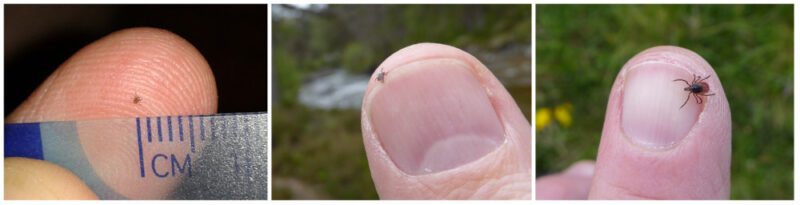
From left to right, larva, nymph and adult
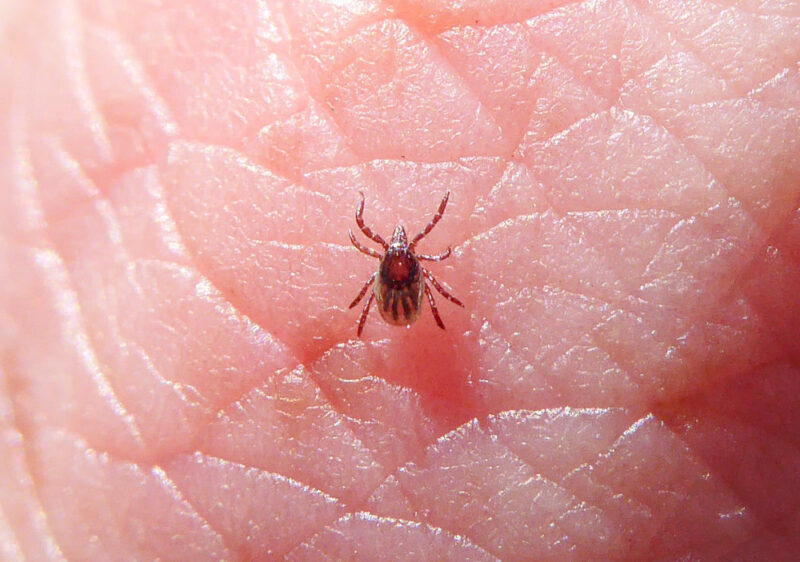
When ticks hatch from eggs into tiny larvae, they have six legs. This doesn’t make them an insect, however. They’re an arachnid, closely related to spiders. You’ll be doing well to notice the number of legs at that stage, however, as the larvae are so small as to be almost invisible. Half the size of a poppy seed.
You might hear it said that larval ticks can’t infect you with the Borrelia bacteria because the parents can’t pass the infection on to their eggs. That’s generally true for *some* species of Borrelia, including the ones traditionally linked to Lyme Disease, but apparently other Borrelia species CAN be passed to the eggs, and so while there is likely a lower risk of Lyme Disease if you’re bitten by a larva, I still wouldn’t assume there’s zero risk from other (related, though admittedly rare) diseases.
Ticks need a blood meal to progress through each stage of their lifecycle. After the larva has fed, it moults (including growing an extra pair of legs), and becomes a larger ‘nymph’, between 1 and 2mm long. After its next meal, it moults again into a much larger adult.
Adult ticks will then mate and die, but not before laying up to 2000 eggs. That’s a lot, but won’t come as a surprise to anyone who has had the misfortune of resting unawares on a newly hatched tick nest!
After each meal, ticks retreat to the ground, as digestion and moulting take time. They can potentially complete their full lifecycle in as little as two years if climate and host abundancy are favourable, but in Scotland most ticks will complete just one lifecycle stage per year, across three years.
Where and when?
You’ll find ticks in most vegetated habitats, including bogs, moorland, woodland, coastal dunes, parks in towns, even in some gardens, but there is a strong correlation with areas that have high deer populations. So, those inviting flat islands of grazed, green grass in rugged glens that look improbably perfect for camping? Yeah, I’d think twice.
In terms of tick activity, there has traditionally been a winter dormancy period, driven by low average temperatures and short daylight hours. Research from Central Europe suggests that in colder periods, daylight length has an impact on tick activity, with ticks becoming active when there’s around 12hrs of daylight, and inactive at 9hrs. In Scotland that broadly corresponds to mid-March until late October, but examples abound of ticks being seen in mid-winter, and there’s evidence to suggest that prolonged mild winter weather can override any light-driven cues the ticks might otherwise be sensitive to.
Importantly, winter cold doesn’t bring about a mass death of ticks. Experiments in laboratory conditions found ticks would indeed die if exposed to sustained periods below -10C, but that doesn’t mean that a week of nights below -10C on a Scottish hillside will purge the place of ticks. Once you get down into the vegetation, soil or snow you’re insulated to some extent, so it’s unlikely to be cold enough, for long enough, to kill ticks off.
A temperature of around 6C is generally cited as the threshold for tick activity, but I wouldn’t assume that a 4C day is guaranteed to be tick-free. I’ve occasionally picked up ticks when it’s colder than 4C (but still above freezing), so use that as a general guide only. However, given that ticks like warmth and wet, and our winters are getting both warmer and wetter, well, I think we can all see where this is going.
Perhaps more important than temperature however, is moisture, as sustained low relative humidity is more likely to kill ticks than the cold or the heat. Ixodes ricinus ideally needs 80% humidity, which you’re more likely to find closer to the ground in densely vegetated, moist areas where humidity is highest.
The quest
Ticks move up and down vegetation, depending on the weather, and the movement upwards in search of a host is known as questing. The tick will first climb to a lofty position where a potential host is likely to brush past.
Ixodes ticks don’t have eyes, instead they have highly-sensitive organs on their front legs, known as Hallers Organ, to detect changes in the environment. This makes them highly sensitive to changes in humidity, heat and carbon dioxide, enabling them to detect an approaching host from many metres away.
Alert to an opportunity, the tick waves its front legs in the air in readiness to latch on with wee hooks, which help them grab hold as you brush past. However, unlike midges or mozzies, ticks aren’t fast feeders. Once they’re on you they’re largely unfelt and unnoticed, so can afford to take their time in finding an optimum feeding spot.
They’ll roam around in search of thinner skin near to a good blood supply, so ideally the underside of arms, back of knees, thighs, groin etc. Both of my bites this time were higher up, above the knee, so the ticks had likely entered via the trouser leg and then done some climbing, which would obviously take time for something so small.
The bite
People talk about the tick’s head being buried in your skin, but that tapered bit protruding from the front of its body, the bit that attaches to your skin, is not a head. It’s called the capitulum – an assemblage of mouthparts (hypostome and palps). Not all tick species have eyes, but on the ones that do, the eyes are at least a third of the way back along their bodies.
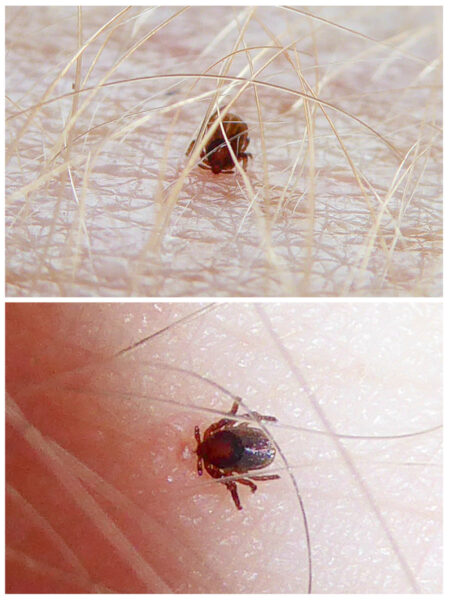
The hypostome is the central appendage through which ticks feed. It is barbed like a harpoon, which is why ticks are so very difficult to remove. The hypostome is encased within two closed palps for protection, which open up when the tick is ready to bite.
You won’t feel the actual bite, but if you’re lucky you might feel the reaction to it later. Apparently, it’s unusual to feel an itch after the tick bites, but I certainly do, and I therefore count myself lucky that I’ve been sufficiently sensitised to tick bites for my body to give me warning signs. One of my biggest pieces of advice therefore, is if you feel an itch don’t just scratch it absentmindedly and resume what you’re doing. Yes, it’s probably a midge bite, but take a quick look regardless, just in case.
Gone unnoticed, ticks can remain attached for a few days while they feed. Assuming you notice the tick quickly, you might take comfort in the numerous sources online saying that the risk of infection is low if you get the tick off you within x number of hours. Typically 24 or 12. This reasoning stems from research into the time it takes Borrelia bacteria in the tick’s gut to respond to the influx of blood from a new host, and move from the gut to its salivary glands.
However, you’ll also find legions of people who say they had a tick attached just for an hour or two and they still picked up Lyme Disease. Both things can be true, because while you can have general guidelines that apply much of the time, you can also have exceptions that don’t. Either way, chances of infection increase the longer the tick is attached, and other infections can be passed more quickly than Lyme Disease, so removing the tick ASAP is best.
Removing ticks
Crucially, when you find a tick, don’t panic, but if it’s in an inaccessible location you might need to ask some brave person to remove it for you. You want to remove it intact, without stressing or squeezing it, because this can result in the contents of the tick’s gut being regurgitated into your body. So no burning, no suffocating it with Vaseline, no pinching it using fingers or blunt tweezers etc etc. Use dedicated tick-removal tools.
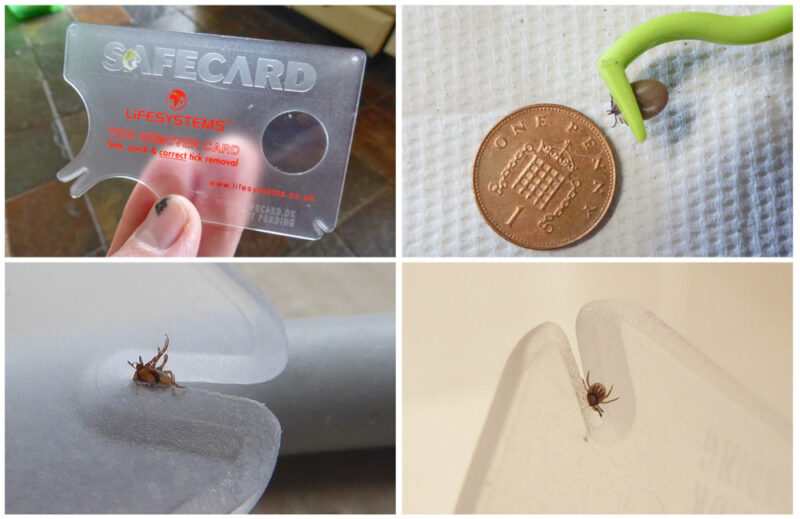
Those tick twister things folk use on dogs are quite popular but I’ve never found one that can get the tiniest ticks out. I find the plastic credit card-sized tools much better. Not necessarily the ones you sometimes get handed out for free by charities, mind, as they often have slits too large to remove the tiniest ticks. Personally, I’ve never met a tick that the Lifesystems card couldn’t remove. It has a magnifying glass and two different sized removal tools suitable for different sized ticks, but specialised tick tweezers are a good choice too.
After removal, wash the bite and then get on with your life. At the very least, your immune system will probably respond to the bite in the way it does for most beastie bites – a small welt and/or area of redness. Personally, I find tick bites more infuriatingly itchy than those of mozzies or midges. But all being well, that’s the worst that will happen.
Every patient though, regardless of how soon the tick was removed, should be vigilant for unusual symptoms in the days and weeks afterwards. People talk about the famous ‘bullseye’ rash as being diagnostic of Lyme infection but: a) not everyone with the infection gets that rash; b) not all rashes have the bullseye appearance; and c) rashes can appear in places other than the bite site. You should also be vigilant for flu-like symptoms – aches, pains, fever, fatigue etc – in the weeks that follow. If those do surface, then it’s GP immediately, and probably a course of antibiotics.
Raising awareness
All this doubtless sounds nightmarish and scary but, ultimately, basic awareness is our friend when it comes to ticks, because how can you defend against something if you don’t even know what it is or what it looks like? It’s regrettable, therefore, that there still seem to be shortcomings in that regard.
I meet a great many people who either don’t think (or don’t know to think) about ticks at all when they head outdoors, or don’t know what they need to be on the lookout for. In my experience, almost everyone who has never seen a tick expects them to be big enough to see at arm’s length. Or if they have seen one, it’s been an engorged one on their dog, and they’re expecting something that size.
I remember meeting a visitor at the Linn of Dee car park who said they had never seen a tick. ‘One moment….’ I replied, and swept my hand through the grass where we stood, thus revealing a couple of tiny ticks on the back of my hand. The visitor was astonished at how small they were.
Tellingly though, she visibly flinched to see me willingly put myself in contact with a tick. I reassured her it was fine, it wasn’t going to bite in an instant, but it did help me understand the visceral fear and perhaps misunderstanding of the risk there is out there. Ticks shouldn’t induce undue panic and fear. Vigilance, prevention and swift action, yes, but not panic or fear.
It can be difficult though, as education isn’t always welcome. When I was working at West Lothian Council, the Lyme Resource Centre asked the council if they’d support an education campaign in the country parks, to raise awareness of ticks and Lyme Disease.
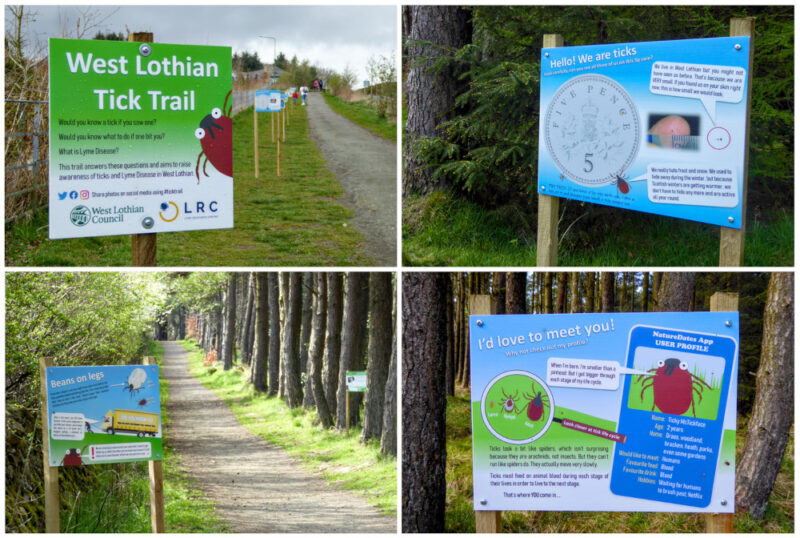
I designed a Tick Trail, a sequence of six light-hearted, colourful and cartoonish boards that people could read as they walked along a path. It was sprinkled with quick tips on tick ID, health-care advice on removal, and ‘did you know?” facts to try and make the subject more accessible.
It was generally well received but we did get a few comments about how unwelcome such a visible campaign was in a family setting, saying they didn’t want their kids to be confronted with the existence of ticks, as it was too scary.
I’ve seen primary-age kids deal with ticks in a more matter of fact, calm manner than many adults – but I’m firmly on the side that says basic awareness is essential for getting them accustomed to a) the existence of ticks and b) what they look like so that they can tell their parents if they have one. Ignorance might be bliss, but it certainly isn’t protection.
Prevention
Despite my own lapses in protection, I’m still consciously cautious outdoors. I generally avoid walking through prime tick habitat in summer if I can help it, and depending on where I am, I’ll try to find a rock to sit on rather than sitting down on the ground, plus I’m careful about where I put down items of clothing, or my camera case. If I’m working in woodland I’ll hang rucksacks and jackets high up on branches rather than put them down on the ground.
Even for toileting, I‘d always check my hands and the front of my trousers before going for a pee. And if it’s the crouching kind, I’d recommend being mindful of any blades of grass or rushes etc tickling your behind, as there could be ticks questing on the ends!
I almost never wear shorts. Partly ‘cause I’m a pale ginger and can’t bear smearing suncream over such a large area, but mainly because of ticks. I usually wear gaiters when I know I’ll be off-path, especially lower down in the glens. Temporarily tucking trousers into my socks works well as an emergency measure, and when I do emerge from long vegetation, I’ll quickly scuff my legs and gaiters with my hands to dislodge any hitchhikers.
I don’t tend to use insect repellent for ticks, specifically, but throughout the summer I apply it to all the clothing ‘entrances’ to deter the midges and clegs, i.e. ankles, waists, wrists, neck etc, so this does help ward off ticks too. I draw the line at using Permethrin clothing or spray though – yes, it’s a proven barrier against ticks but it’s also an indiscriminate insecticide. When I’m out and about, I love interacting with moths and ants and beetles and wasps or whatever other insects I bump into, and I don’t want to be causing collateral damage.
Such a long list of precautions might sound excessive but each behaviour has been adopted due to personal precedent, and is something I’ve easily integrated into my working or walking routines without inconvenience, and without compromising too much on the places I like to go during the summer.
Ticks are serious, yes, but while we should be alert to the dangers and adjust our behaviours or activities accordingly, we shouldn’t live in fear of them or let them prevent us from enjoying the great outdoors. Getting out & about, getting fresh air and natural light, is still the healthier option.