

Back in the depths of winter I was clearing away an old campfire site in a far-flung corner of woodland, and there was a big piece of soggy deadwood, a log, that had been put on top of the fire. Clearly it was never going to burn, but that hadn’t deterred whoever’s fire it was. The centre of the log was singed but the ends were not.
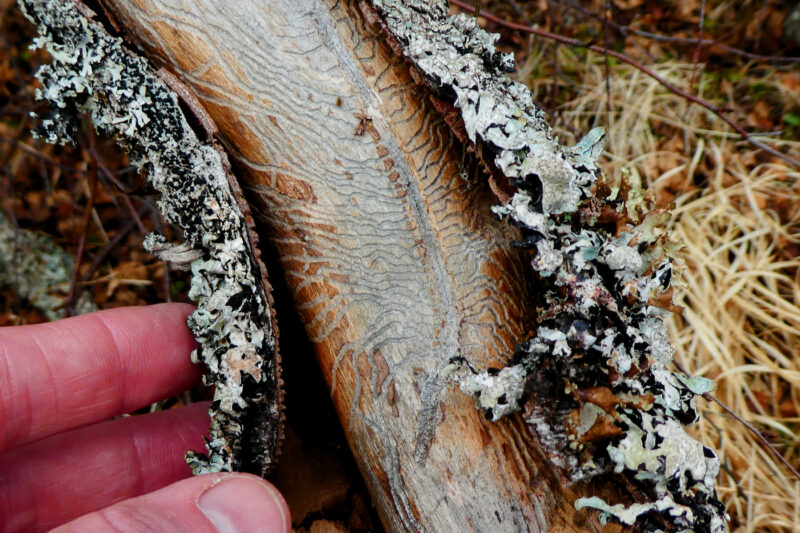
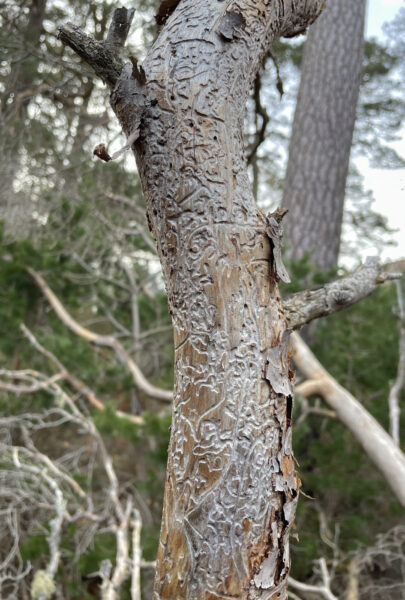
As I crouched down, I noticed a striking pattern on one unsinged end. A jumble of lines and indentations in the wood, looking like a hectic road map, and so sharply-defined you’d be forgiven for thinking someone had carved them.
Patterns like this are commonplace in the pinewoods, but this particular one stood out on account of its beauty. Decomposition and staining on different parts of the face had given it a lovely two-tone effect, the thick lines tan-coloured against a purplish-brown background. It had a lustre, almost like metal.

But where do those markings come from? Well, if you found this kind of thing in the wood of your home, you’d call it ‘woodworm’. This, despite the fact that woodworm aren’t worms, rather they’re the wood-boring larvae of certain beetles. Similarly, the markings on this log are in fact the workings of invertebrates. Mostly (but not exclusively) beetle larvae.
Larvae, often referred to as grubs, are the immature form of the beetle. They bore through the wood, unseen below the bark of recently felled trees and fallen branches, painting these exquisite ‘larval galleries’ as they go.
Each one is a miniature work of art, utterly unique in form and arrangement. However, while I’ve generally always been aware of larval galleries, I can’t say I’d ever really thought much more about them beyond the superficial aesthetics of the wider scene on the log. I’d never looked closely at what was going on in that seemingly random maze of madness. I’d never looked close enough to notice there might be discernible patterns or structure hidden within the jumble. It never occurred to me there could be method to the madness.
After encountering this particular work of art, I became more interested and started reading up on them, and it turns out that larval galleries come in various recognisable patterns.
Yes, galleries can be higgledy-piggledy and incoherent, all over the place like spaghetti, but they can also be symmetrical, resembling fish bones or bird wings, star explosions, or even tuning forks. You can get different patterns next to one another on the same log, and the general layout of an individual pattern can get you well on the way to identifying what species of beetle was responsible.
I say well on the way, because identification is also informed by a whole host of other things: location in the wood; width of the tunnels; the pupation chamber; but also the size and shape of the ‘exit’ holes that the new beetles bore in order to escape into the outside world. Most intriguingly of all, identification can be aided by the presence or absence of ‘frass’. Rather satisfyingly, frass was a word I’d not encountered before, and refers to the waste material, a fine sawdust, produced by the beetles when tunnelling.
I wondered how easy it would be for me, a complete novice, to identify these larval galleries to a species level? Turns out, not very!
Initially my hopes were high because there’s plenty of information about the general behaviour of wood-boring insects out there. Annoyingly though, as with wasps, much of the most readily available stuff online is geared towards domestic pest control, which doesn’t really help me in a Caledonian pinewood.
I had hoped there might be plenty of photos like mine, saying ‘made by insect x, the most commonly found boring beetle in Scots pine in Scotland’. But no. And if I did find a photo of larval galleries on a Scots pine in Scotland, they didn’t look much like mine.
Even finding out what the most likely culprit for such patterns in a Scots pine might be, was difficult. A lot of the information is locked up in peer-reviewed papers, behind paywalls, for VERY niche audiences. The few papers I could access were mostly central European, or North American in context, and I wasn’t sure how well these would translate into a Scottish context.
Ugh, you never have this problem with white tailed eagles and red squirrels, attention-grabbing creatures that they are. They’re documented to within an inch of their lives. But insects that creep people out when they land unexpectedly on their picnic blankets? Not so much. And as for the entirely-unseen larval grubs of insects that creep people out when they land unexpectedly on their picnic blankets, well, you have your tumbleweed moment right there.
I instead scaled back my ambitions, contenting myself to simply head back out into the pine woodland with the sole objective of finding different patterns, sizes and examples of galleries. And if I could find some frass, or evidence of a pupation chamber, then I’d be happy.
Pine is great. It’s resinous and therefore survives a long time in the environment, but hardwoods like birch break down quickly. Perhaps for that reason, I didn’t find much on the old birch logs. The birch here is old, and so most logs and limbs are generally in an advanced state of decay. However, when I investigated old, still-standing birch, I found fissures in the bark where the tree was stressed or damaged. Imagine my excitement when I found one of the textbook ‘fishbone’ patterns neatly framed in the fissure. It was clearly very different to the patterns on the pines. Could it be Scolytus ratzeburgi, the Birch Bark Beetle? Hmm. Most sources indicated that species is restricted to only a few locations in Scotland, so I’m currently none the wiser. It was fun to try and find out, though!
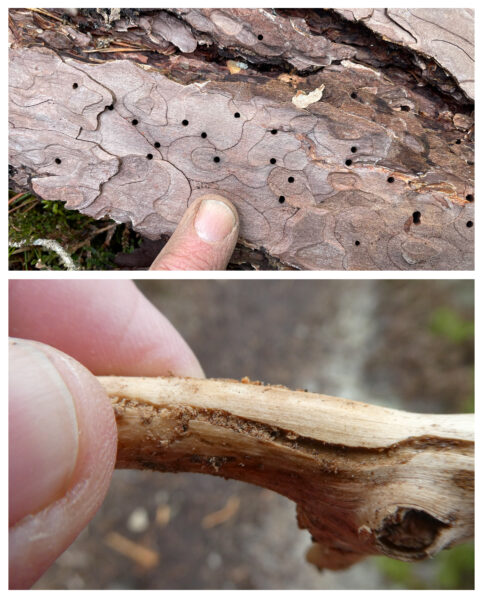
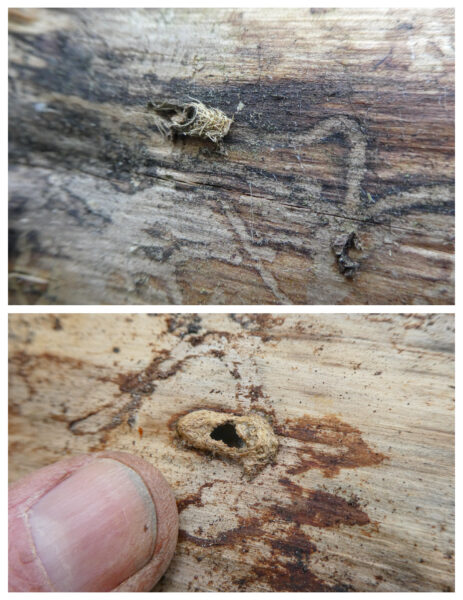
Looking more closely at pine logs and branches, I found tunnels of different widths, depths and sizes, and indeed a variety of patterns. I found plenty of exit holes in the bark and yes, I also found tunnels very clearly packed with a fine sawdust-like material. Was this the frass I’d read about? I also found softer, raised, oval-shaped features on the barkless wood, with a single hole in the middle. Pupation chambers, presumably?
Most surprising to me though, when I turned my attention to all the woody material on the forest floor, was that even small twigs, between 1 and 2cm thick, had larval galleries on them. I’d only ever looked closely at large logs and trees, but apparently, different species of beetle favour different thicknesses of wood. Some actively favour the small twigs, others the larger branches.
Different species have different niches, and different tolerances. But there was no denying that almost every bit of wood on the forest floor, more than about 1.5cm in diameter, had been inhabited by something. So much life!
The importance of deadwood and decomposition is something I’ve covered before for Walkhighlands. When a tree dies or drops a limb or branch, decomposition is a long process during which the components of the wood (cellulose, hemicellulose and lignin) are broken down and returned to the environment as inorganic, mineral forms. For large pieces of Scots pine this can take decades, but steadily and surely, the wood is broken down and will ultimately disappear, having been consumed and recycled by all manner of organisms.
Wood on the forest floor is of notable importance. Frederick Hunter, in Ecology of Pinewood Beetles, says that a whopping ‘64% of the beetle species associated with Scots pine are found in stumps, logs, branches and twigs’. Interestingly, that study also highlights how even individual logs will have drier and wetter parts, or parts in earlier or later states of decomposition, where each micro-habitat favours a different species mix of beetles.
In newly dead or dying wood, the heartwood (inner) and the bark (outer) are hard and especially difficult to digest. The layers between them, and in particular the interface between the phloem (just below the bark) and the xylem (the outer sapwood), are softer and more nutritious. Nutrition is relative though, where woody matter is concerned, but this is where you’ll find the cambium, that layer that feels moist and slimy when you remove the bark. It is very thin, and is responsible for producing new cells, ie wood growth.
Among the earliest beetle colonisers of deadwood, therefore, are those that like to use, or feed upon, these softer intermediate layers. My impression is that this is when most of the galleries I’ve seen tend to be formed, but these parts of the tree are also the parts that contain the plumbing. They facilitate the movement of nutrients and moisture up and down the tree, such that when the means of movement is severed by boring beetles, a still-living tree can suffer adverse effects, compounding its stress.
For the beetles we’re looking at here, the colonisation process starts when a tree is damaged or weakened, such as when a limb snaps off, or there is storm damage or disease. This attracts the first wave of colonisers, which is, for some species, done via their sense of smell. A Swedish study in 1985 found that Tomicus piniperda, the Common Pine Shoot Beetle:
‘can recognise while still in flight a host tree (storm-injured Scots pine) and whether it is susceptible by means of olfaction of three plant monoterpenes evaporating from wound oleoresin.’
Monoterpenes are volatile organic compounds. Examples such as pinene and limonene are in everyday household use for their scent and degreasing properties, both being used in household cleaning products, but they’re naturally occurring in many trees, especially pines, and can carry great distances .
Other beetle species are attracted en-masse by pheromones from individuals of the same species, emitted when they find a suitable host tree or log. This can lead to rapid colonisation, and even infestation.
A study in the Czech Republic, of 128 ring-barked Scots pines, found a mean average of 10.7 months, between damage being done and the first boring beetles arriving, although this depended upon the time of year that the tree was damaged, and masks the shortest timescale before colonisation. The earliest arrivals occurred within just one month.
But even in the early colonisation stages, it’s not a mass rush of every pinene-loving, wood-boring beetle in the vicinity. Tomicus piniperda, a common bark beetle in Scotland, is an early coloniser, appearing to favour uninfested logs. Tomicus minor, the Lesser Pine Shoot Beetle, another native beetle here, arrives later. T.minor is seemingly attracted to vapours, yes, but also waits for those vapours to be mixed with the smell of T. piniperda having already arrived.
Later still, the larger longhorn beetles arrive, as they favour wood in a more advanced state of decay. And not just beetles, of course. Also weevils and sawflies, such as the giant horntail (or wood wasp).
The colonisers arrive at the tree or log as adults, and set about laying their eggs. Some bore down through the bark and lay their eggs in the layers below, others lay eggs in fissures or crevices on the surface of the bark itself. And some creatures, such as the sabre wasp, use their ovipositors to drill through the bark and lay their eggs INSIDE the larvae of other wood-dwelling species. Gruesome!
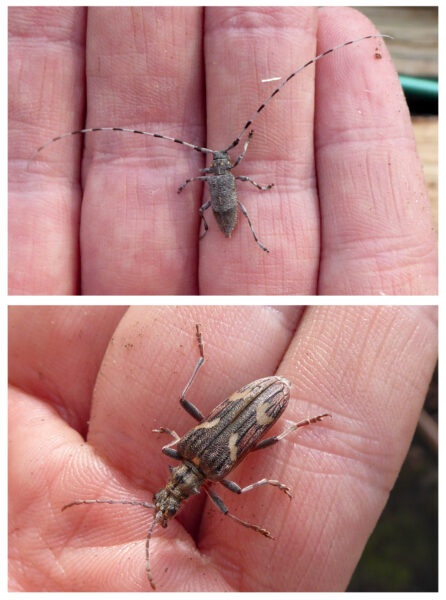
With all this digging and tunnelling, there’s a nice employment of mining language when people write about wood-boring beetles. It’s a world of tunnels, chambers, galleries and systems. Unlike miners, bark beetles are typically cylindrical in shape, well suited to tunnelling, with short antennae and very strong mandibles for chewing through the wood. That’s not to say, however, that short antennae are the only kind of antennae you’ll find within the wood. The timberman beetle, for example, emerges in adult form with the longest antennae you’ve ever seen!
For their tunnels, these early waves of colonising bark beetles generally favour the phloem, into which they will tunnel a ‘mother’ or ‘egg’ gallery. It’s a long, straight or s-shaped feature, along which the eggs will be laid.
T. piniperda, our well-used example, and a likely candidate for tunnels found in Scots pine, tunnels parallel to the grain of the wood i.e. if you looked at a standing tree, the tunnel would be orientated vertically. T. minor, however, bores across the grain of the wood, i.e. horizontally.

When the eggs hatch, the small larvae start boring outwards from the mother gallery, and it is the behaviour and direction of this mass exodus that gives each larval gallery its distinctive appearance. T. piniperda’s larvae head away from the mother gallery, orderly at first but soon veering in all directions. T. minor larvae do the same, but keep a more even distance from one another before boring deeper into the wood, which gives their larval gallery a more ordered, geometric and symmetrical-looking appearance. Longhorn beetles on the other hand, tend to tunnel long, solitary, wavy lines.
It’s also thought that bark beetles utilise sound or vibrations to help steer them away from adjacent beetles and competition, keeping their galleries apart.
As the larvae grow, their tunnels get wider, which is clearly visible when you look at abandoned galleries. To enable this growth, larvae will shed their skins periodically as they grow. Each of these growth spurts is called an instar.
The length of time that a species spends as a larvae is different for every species, but because wood isn’t particularly nutritious, they must spend a relatively long time eating enough of it to be able to pupate. Some bark beetles, such as the Tomicus species, spend only a couple of months developing, in which time they will tunnel about 10cm within the wood.
The larger longhorn beetles will spend a couple of years as larvae, which is why they can grow so big. But in most cases, regardless of size, the greater portion of these beetles’ lives is spent as larvae, in the dark, completely hidden from view below the surface of the bark or wood.
When their growth is complete, the larvae make a new chamber, in which they transform (pupate) into an adult beetle. From what I can tell, this final stage generally takes a few weeks, after which they hatch out and bore their way to the surface. And then, just like that, the beetle is gone.
They leave exit holes that seem to pepper the surface of wood and bark. The size and shape of the exit hole corresponds to that of the newly emerged adult. Bark beetle holes will be small and round, just a couple of millimetres across, whereas you could likely get a pencil into the larger beetle holes.
As far as we’re concerned, the beetles leave behind visible evidence that they inhabited the wood – curious holes and beautiful lines across the surface of the wood. But for the rest of their ecosystem, the beetles’ legacy is more practical and meaningful.
The tunnels themselves can be homes for other creatures that come after them, such as mason bees and potter wasps, but wood-boring beetles play a huge role in decomposition. In controlled conditions, deadwood that is kept free of insects takes significantly longer to decompose. Wood-boring beetles help separate the bark from the wood, aerate the interior, and facilitate access into the wood for microbes and fungi.
Beetles can of course wreak terrible economic impact if a non-native species arrives. The Scottish forestry sector is always on the lookout for dangerous new arrivals, such as the Eight-Toothed Spruce Bark Beetle, which was possibly, accidentally, imported from Europe in infected wood. It loves spruce, and therefore poses a substantial threat to Scotland’s spruce plantations.
Even native beetles can pose a threat to forestry if populations explode, or if they unwittingly find themselves in a symbiotic relationship with a new, non-native fungus. This is what happened in the last century with Dutch Elm Disease. It’s caused by a fungus native to Asia, which was inadvertently introduced into parts of the world (including the UK) where trees hadn’t evolved to co-exist with it. The fungus used our native elm bark beetles as unwitting vectors for spreading inside elm trees, and as a result much of Britain saw elms completely wiped out. Symbiotic relationships like this, between beetles and fungi, are a staple of the natural world, mutually beneficial, and in a stable ecosystem they generally target weakened trees and help maintain a good amount of dead wood in a forest.
It’s a fine balance. Wood-boring beetles bring both destruction and creation, but as initiators of decomposition, the world wouldn’t be the same without them. They’re wee marvels, but what has struck me most in my new exploration of this hidden world is just how much life there is out there. Practically every single piece of wood I picked up or encountered, above a certain thickness, had larval tunnels on it. And yet it all happens unseen, without us noticing. It also brings into focus (yet again!) the importance of deadwood on the forest floor, and how rewarding it can be to take a closer look at the otherwise hidden, boring creatures around you. Boring, yes, but definitely not boring!