

At first it was subtle, barely enough to suggest anything was amiss – a long, flat-topped plateau in the distance, somewhere over towards Drumochter, and I was struggling to identify it.
We do of course have plenty of flat-topped hills in Scotland, especially around Drumochter, but this one was properly flat, like a table. Hmm. I assumed my natural compass was just a bit off, and when I reached the summit I’d take another look and try to work it out.
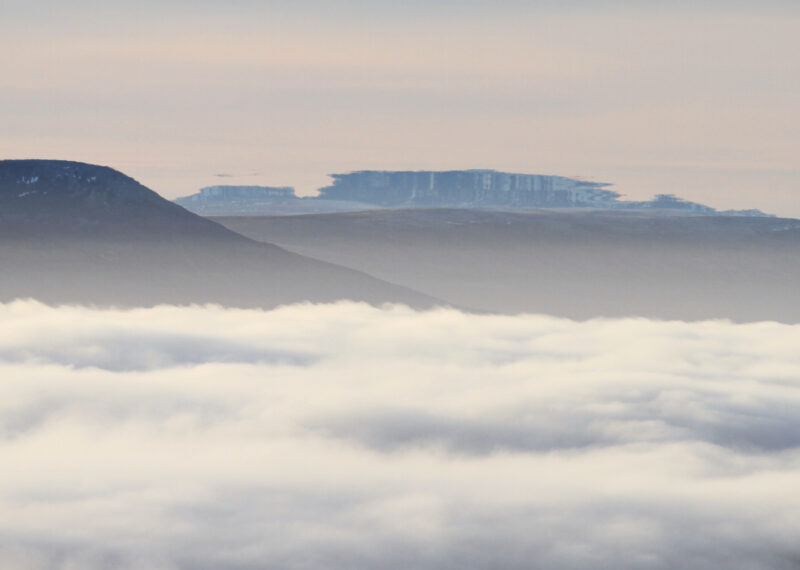
But when I looked back behind me just five minutes later, that flat-topped hill was now whale-backed, and had grown a single, enormous icy tor. Towering above the rest of the hill, the tor was clearly made of earth and rock.
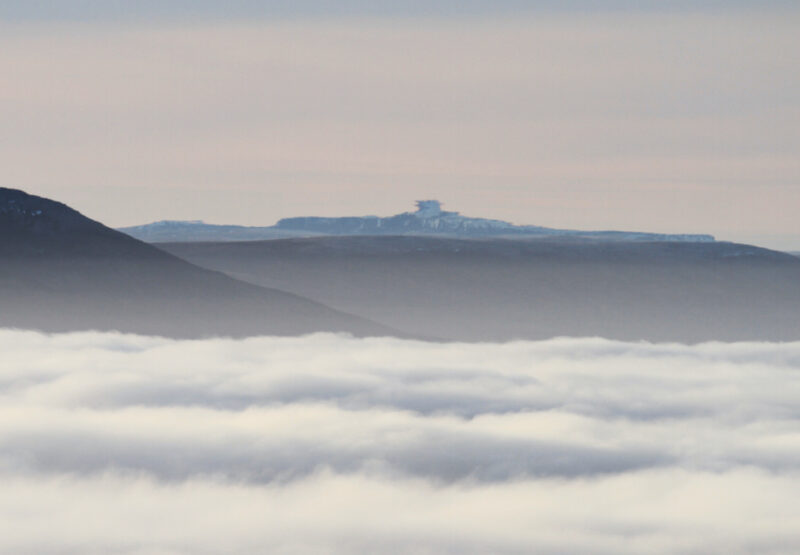
At the summit of Carn na Drochaide I scanned the horizon more widely and there were now several other craggy towers, rising skyward. Before long, the distant horizon was conspicuously ‘weirding’, developing into a hyper-real, blocky landscape of ice and rock towers. Real mountains but somehow…… not.
It’s not an implausible landscape when this happens. Indeed, if you knew nothing of Scottish topgraphy, at first glance you could be forgiven for thinking these icy lumps were weird but natural ‘inselbergs’. ‘Island mountains’, their prominences isolated by relatively low, flat land around them. Such features are widespread around the globe. But to me, and to anyone else even vaguely familiar with Scotland, utterly unreal.
I couldn’t really see them changing while I stared at them, but they were changing quickly enough that I noticed the difference after I’d spent just one minute retrieving coffee and cake from my bag.
Looking closer, through a zoom lens, I could see that the mountains were a bit fuzzy at the edges, or their features looked stretched. It reminded me of when paper gets stuck in a printer, and you get a concentration of repeated detail in one place.
‘A glitch in the matrix?’ perhaps?
Nope. This is a complex mirage, not uncommon in Scotland under the right conditions, but I can count on one hand the number of times I’ve seen it. This is Fata Morgana, which is Italian for ‘Morgan the Fairy’.
Depending on where you’re from, you might know Morgana by other names too, but she is commonly known as Morgan le Fay, which means the same thing. She features prominently in the Arthurian legends, but what was she doing in Italy to have given her name, in Italian, to a weird mirage?
After the Battle of Camlann, Morgan was said to have taken an injured Arthur to Avalon to heal. Avalon was an island, a paradise on earth, and many beautiful places around the world lay claim to that title. Glastonbury of course, but also locations in Ireland, Scotland, Wales and beyond. Sicily is one of the more enduring claimants, the Arthurian legend seemingly having been carried there by Normans when they invaded the island in the 11th Century.
Being famed for her magic powers and being able to change shape, strange goings-on in the Straits of Messina seemed evidence enough of Morgana’s presence. For there, she would raise castles and towers from the water.
The scholar, Antonio de Ferrariis, wrote about the phenomenon in 1508:
‘Sometimes you will see cities and castles and towers, and sheep and different coloured cattle and images or spectres of other things, where there is no city, no sheep, not even a thorn bush…….They do not last long, but change as the vapours in which they appear’
The University of San Diego cites 1617 as being the first use of ‘Fata Morgana’ to describe the mirage, and by the 18th Century the term is being used in English too. As time passes by, the science slowly catches up, but there’s little sense of the wonder waning.
To understand what’s going on, we’d best start with what a mirage actually is. Fundamentally, all mirages are a result of refraction. That is, the change in the direction of a ray of light as it passes from one medium to another. Air to water, for instance. Water to glass. But essentially it occurs when light passes through mediums of different densities.
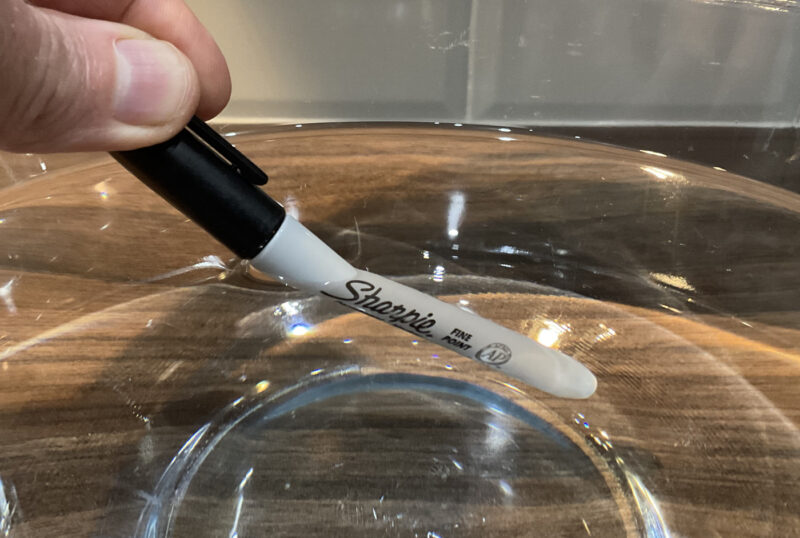
A good example of this is when you reach into a bath of water. Your arm looks shortened or bent. That’s because air and water have different densities, and the light bends as it passes from one to the other. The same happens when light passes from warm to cold air, or vice versa.
Air is made of molecules (oxygen, nitrogen etc), and when you take a pocket of air and warm it up, its molecules absorb energy. With more kinetic energy, they will move about more. As they do so, they spread apart. The mass of that original pocket of air hasn’t changed. You’ve still got the same number of molecules, but they now occupy more space. which means that pocket of air has become less dense.
For the same volume of air, hot air has fewer molecules than cold, and therefore weighs less. Generally speaking, this is why cold air sinks, and warm air rises. How light has its trajectory altered as it passes through these changing densities of air is called atmospheric refraction, and it is this that can produce a mirage.
There are two principal categories of mirage. Inferior and Superior.
Inferior mirages of objects appear lower in your field of vision than the objects really are. Examples are oases of water appearing in a desert, or watery reflections on a road on a hot sunny day,
Course, If I had a photo of a heat shimmer, I’d post it here to illustrate. But this is Scotland, for goodness sake. How often do I get to take a photo of a heat shimmer?! But on days like that, there is a thin layer of hot air directly above the ground, which is much hotter than the cooler air above it.
When the light meets the boundary between the (upper) cool and (lower) hot air, it does so at an angle. Assuming the layers of cool and hot air are arranged horizontally, if the angle is 90 degrees off the horizontal (i.e. the light is shining down vertically) the rays of light go through the boundary in a straight line and are not bent. If they meet the boundary at any other angle, then they’re immediately bent away from the vertical or, as it’s known in refraction terms, away from ‘the normal’.
‘The normal’ is always perpendicular (at a right -angle) to the boundary between different densities. Not all refractive mediums are arranged horizontally (eg. glass, or turbulent water) so the normal is not always the perfect vertical. But for our purposes, and to make it easier to visualise, in this article we’re assuming that layers of warm and cold air ARE horizontal, in which case the ‘normal’ would be vertically aligned.
The reason light refracts away from the normal has something to do with the light changing speed when it meets a medium of a different density. That blows my mind because light travels at the speed of light and surely that never changes? Ugh, don’t worry about that part. Just know that it’s a thing, and it’s the reason that light changes direction as it passes from one medium to another.
To complicate matters further, although I’ve been referring to just two layers of air, cold and hot, in reality the boundary between the two isn’t so clear cut. Even in abrupt changes from cold to hot, which can take place within just a few metres, there is still a gradient of temperature separating the two. The bending of light doesn’t therefore just occur once, upon the light’s transition from a cold layer to a hot layer, rather it occurs multiple times, with refraction occurring at every miniscule change in temperature. So, if the air gets significantly and steadily hotter (and therefore less dense) as the light travels towards the ground, the ray of light keeps on meeting different densities again and again. Every time it does so it veers further away from the normal, and therefore enters each layer of warmer air at a slightly shallower angle than before.
There comes a point, however, when the light’s angle of entry is so shallow that it can’t penetrate the less dense (hotter) air. This point is called ‘total internal reflection’, and is the moment when the light finally bottoms out on its downward journey, like a plane pulling up from a dive, and is reflected back upwards into the cooler layers above. It’s not the same physics as stone skimming off water, as it’s nothing to do with surface tension, but that visual image might help you to picture that moment.
So, ultimately, instead of all the rays of light from a blue sky travelling down from above, in perfectly straight lines into your eyes, some rays will have taken more of a u-shape journey – down towards the ground, along and then up again. When those rays enter your eyes, they’re not travelling downwards, away from the sky above you. They’re instead travelling upwards, away from the ground below you, and while your brain is undoubtedly very clever, it’s not clever enough to realise this.
Your brain’s concept of reality is based upon the assumption that light travels in straight lines. Therefore, when refracted light arrives at your eyes, your brain doesn’t know the difference between a bent ray and a straight ray. It immediately traces the light back in a straight line along its final trajectory and shows you the source of the light (the object), exactly where it believes it to be.
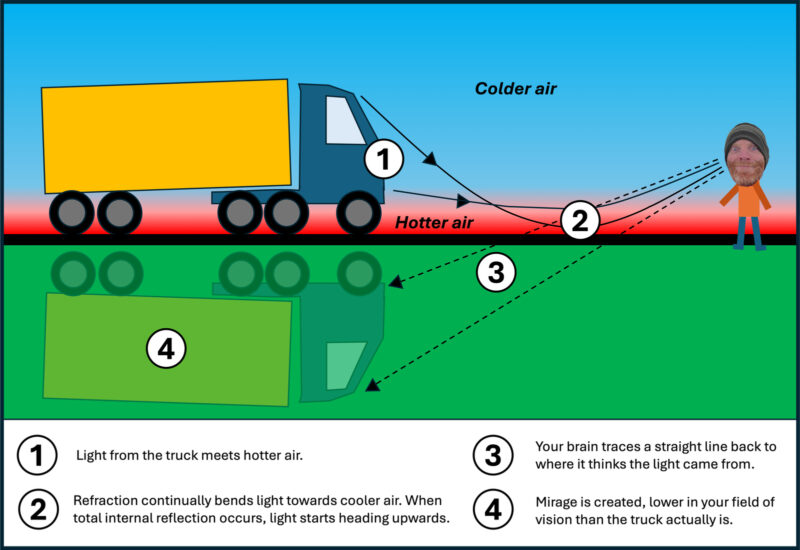
In the case of the classic mirage of a blue lake in a desert, what you’re actually seeing is the blue sky. It’s not an illusion, it’s the real sky, made of real rays of light, it’s just rendered much lower in your field of vision that it should be.
And not just the sky, of course. You’ll see any object further up the road or in the distant desert horizon too – cars, houses, palm trees, sand dunes…..but in an inferior mirage you will see them not just lower than they should be, but also upside down, like a reflection.
However, when there is very cold air held at the surface, trapped below warmer air aloft, the opposite kind of mirage can occur. Think back to the Straits of Messina, a body of water with significant upwelling beneath the surface that can result in the water being notably cool during summer, and much colder than the hot Mediterranean air that passes over it.
Light escaping the cold air at the surface meets the warm air aloft and, this time, because the denser air is below, the light is bent TOWARDS the ground rather than away from it. Again, your brain assumes the straight-line principle and traces the light’s final trajectory upwards as it arrived at your eyes. The result being, that instead of seeing objects lower than they should be, this time you are seeing them higher than they should be. These are ‘superior’ mirages, and they’re probably less familiar to you than inferior ones.
Out at sea, if the difference in temperature isn’t too extreme and the transition between the two is gradual, it can have the remarkable effect where a boat might seem to be floating in the sky, above the horizon. More remarkable still, distant land can appear to rear up over the horizon, even though it can’t be seen on a direct line of sight due to the curvature of the earth. This particular superior mirage is known as ‘looming’. However, if the gradient between the warm and the cold air is especially steep (i.e. extreme), at least 1C increase in temperature for every 10m increase in altitude, then Morgan le Fay comes out to play.
In winter, high pressure can act like a cap over cold air, locking it in place and resulting in cold conditions at the surface, with much warmer air above. This is a temperature inversion, and they can often produce a low blanket of cloud somewhere on the boundary between the warm air and the cold, with peaks popping through. If you’ve ever walked upwards through that cloud, you’ll feel it get much warmer with height, across a remarkably short distance. That’s what happened at the end of December 2025, when I saw my mirage.
Light rays arriving from a long way off (especially those arriving at angle closer to the horizontal) travel up from the cold air below and strike the warm boundary above, but when the gradient is extreme they cannot penetrate it. These are instead refracted back downwards at angles equal to, or greater than the curvature of the earth. These rays, now on straight trajectories in the cooler air, gain height again as the earth’s curvature falls away beneath them, until such time as they meet the warm layer a second time. Again, they are refracted downwards. Rinse and repeat, and you have rays of light that are effectively trapped in a narrow refractive zone immediately below the top of the temperature inversion.
This is called an atmospheric duct, and it allows light to travel much further than normal within the atmosphere. The duct also acts as a refractive lens, and the longer the light spends in there, the greater the opportunities for refraction to occur. That’s why Fata Morgana visibly distorts the most distant objects on (or below) the horizon.
By the time light from the source, in this case a distant hill, reaches your eyes it’s a jumble of rays that have travelled different paths and distances.
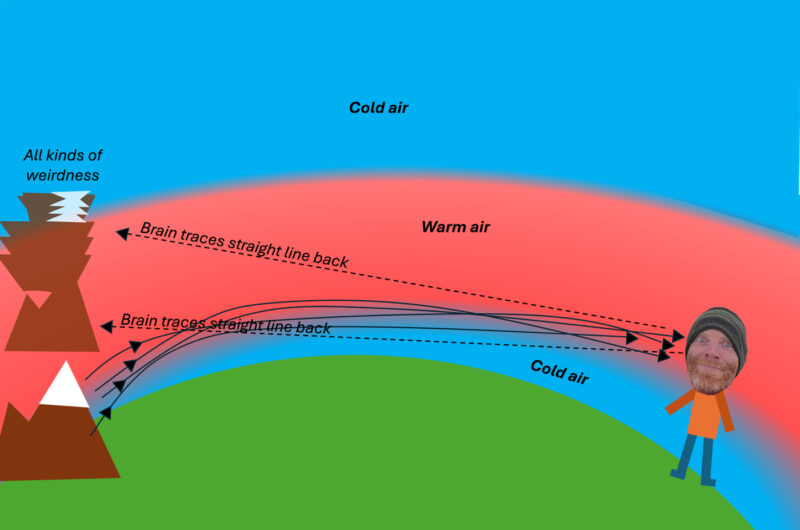
Light is trapped and ‘channelled’ below the warm layer
Your brain processes the information from every ray of light it is receiving, tracing each one back in what it assumes was a straight line to its origin, and renders each part of the image where it thinks it should be. Fata Morgana is a type of superior mirage, so will be rendered higher in the sky than the hill really is, but with light arriving via such a wide variety of angles, the image your brain assembles will bear little resemblance to the original.
Different rays from the same object, such as those reflected off the top of a hill and those reflected from lower down, can also cross over in the duct and effectively swap positions, which can make parts of that object appear to be upside down.
A Fata Morgana mirage can therefore be a mix of everything – multiple or repeated layers and segments, stretched or compressed, smaller or larger, all stacked on one another. It all combines to produce something downright weird. In my case, Arctic inselbergs on a Scottish horizon.
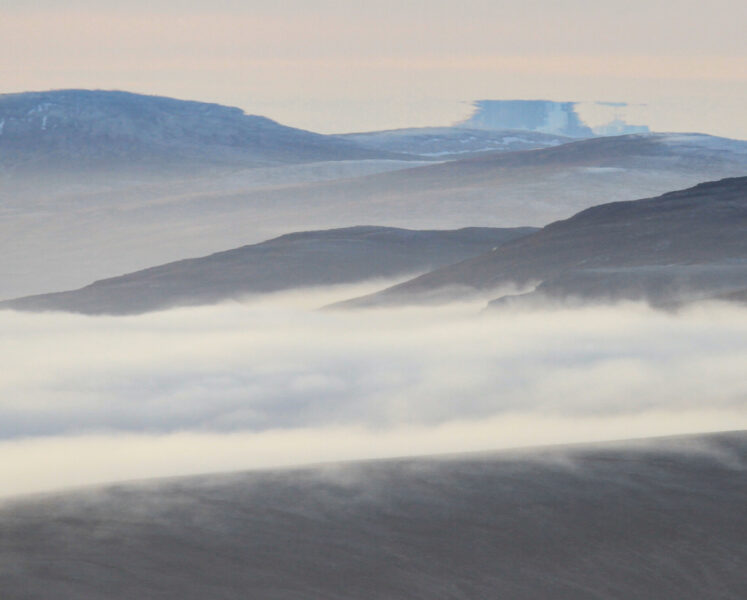
You can well imagine how much fear and confusion Fata Morgana provoked in human beings before it was clearly understood. Somewhat surprisingly though, as recently as the 20th Century, long after mirages had been explained, Morgana was still deceiving sailors and explorers. In particular, the infamous ‘Crocker Land’ expedition to the high Arctic in 1913.
The expedition was following in the respected footsteps of Robert Peary, an American in the US Navy, who explored widely in the Arctic at the turn of the century and was, for a while, credited as being the first explorer to reach the North Pole.
In 1906, on an earlier and failed attempt at the pole, Peary found himself atop a lofty cape, just off the edge of Ellesmere Island. There, he claimed to have sighted a land of towering mountains and ice, at least 120 miles away, writing:
‘my heart leaped the intervening miles of ice as I looked longingly at this land, and in fancy I trod its shores and climbed its summits’.
Peary later named it Crocker Land, after George Crocker, one of his wealthy patrons. Unsurprisingly, the lure of this vast and unexplored new land was hard to ignore, and in 1913 another US Navy officer, Donald B MacMillan, lead an expedition to Crocker Land.
MacMillan provisioned carefully for the length of time he’d need to spend on the sea ice beyond Ellesmere. Given Crocker Land was 120 miles offshore, he reckoned on 25 days of provisions: 12 days out, 7 days back, a few days to explore Crocker Land of course, plus a few days in reserve.
In April 1914, nine months after sailing from New York, and six weeks after starting their overland expedition from their base in Greenland, the team sighted land while they were crossing the sea ice.
“Great heavens! What a land! Hills, valleys, snow-capped peaks extending through at least 120 degrees of horizon, – I turned to Pee-a-wah-to anxiously and asked him toward which point we had better lay our course. After critically examining the supposed landfall for a few minutes, he astounded me by replying that he thought it was poo-jok (mist).”
True enough, the snow-capped peaks disappear from sight as the day progresses, leaving the team to ponder, could Peary….
‘….with all his experience have been mistaken? Was this mirage which had deceived us the very thing which had deceived him eight years before?’
MacMillans’ team wisely took observations to confirm their location. They established they were 150 miles out to sea and, upon having this confirmed, MacMillan wryly remarks in his book how this meant they were now, according to Peary, ’30 miles inland!’.
MacMillan knows they’re not, but he dares to hope. Indeed they pressed on a bit further, but in his writings you can sense they’d already given up.
‘You can imagine how earnestly we scanned every foot of that horizon. Not a thing in sight’. Not even the mirage……We were convinced that we were in pursuit of a will-o’-the-wisp, ever receding, ever changing, ever beckoning
I can’t imagine the disappointment they must have felt, out on those pressure fissures and sea ice cracks, upon realising that they were chasing a mirage. It must have been crushing.
On the return journey, at Axel Heiberg Island, they successfully located the very cairn that Peary left at his ‘Crocker Land’ viewpoint:
The day was exceptionally clear, not a cloud or trace of mist; if land could be seen, now was our time. Yes, there it was! It could even be seen without a glass, extending from southwest true to north-northeast. Our powerful glasses, how-ever, brought out more clearly the dark background in contrast with the white, the whole resembling hills, valleys, and snow-capped peaks to such a degree that, had we not been out on the frozen sea for 150 miles, we would have staked our lives upon its reality……Our judgement then, as now, is that this was a mirage or loom of the sea ice.
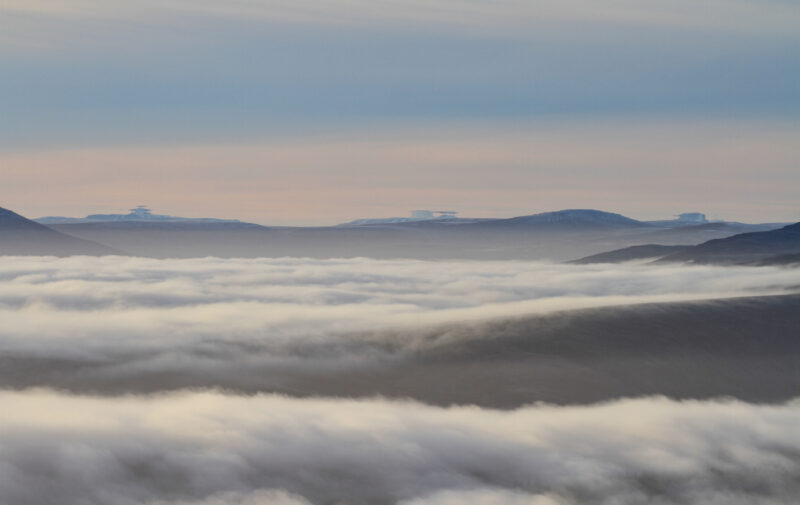
The opinion these days seems to be that Peary was too experienced an arctic explorer, and too familiar with Inuit knowledge to have mistaken a mirage for mountains. Some suggest, therefore, that he concocted Crocker Land to keep interest in arctic exploration alive. But it’s clear that MacMillan wasn’t entirely dissuaded of its existence even after that first ‘misty’ sighting. Having seen inselbergs and Arctic plateaux from Carn na Drochaide last month, I can understand the allure, for while Fata Morgana alters landscapes in extreme and exaggerated ways, her handiwork can still be both weirdly plausible, and undeniably enticing. I’ll certainly be sparing her a thought the next time I’m ascending through a cloud inversion, and will consider myself privileged if Morgan le Fay comes out to play.