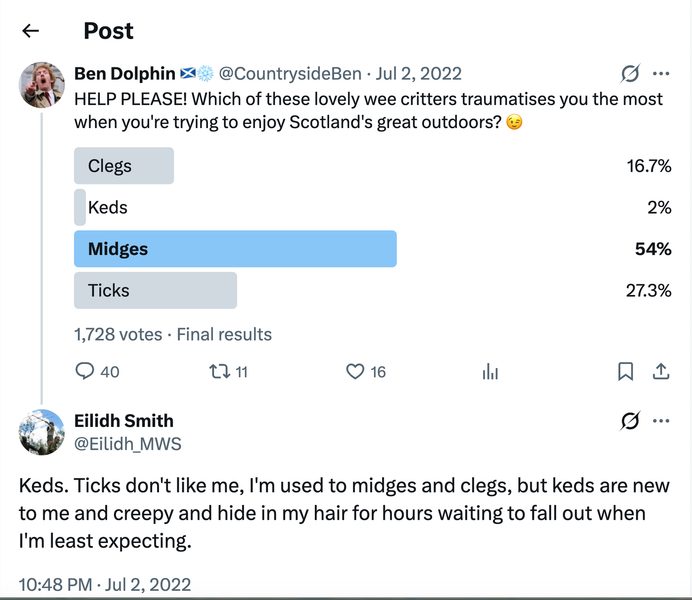
In my last article I wrote about clegs. And in the article before that, I wrote about ticks. Given this latest article’s subject matter, some might accuse me (not unreasonably!) of being obsessed with wee biting beasties, but this time around I was genuinely intending to break the theme and instead write about something nice and inoffensive. Something pretty, or maybe something fluffy. Rowans, perhaps. Or roe deer.
But then last month, as fate would have it, I was set upon by the largest concentration of keds I’ve ever encountered. A newsworthy concentration, for sure. And so here I am, cathartically writing about yet another biting beastie, and thus completing a summer triptych of ectoparasites. Yes, it’s been that kind of year I’m afraid!
Early in September I was having a lovely day in Glen Lui, trudging across open moorland and snapping fixed-point photos for a long-term project at work. It was calm, sunny, warm….and uneventful.
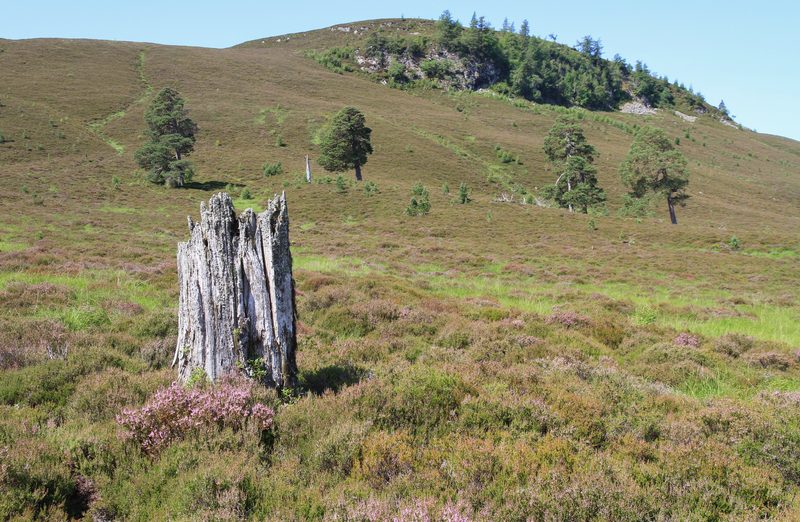
But as I passed under a solitary, big old pine tree I was suddenly aware of a cloud of insects buzzing around me. There were so many that at first I thought they could only be midges, but I quickly realised they were much larger.
By that point it was well past cleg season, so it couldn’t have been them. Curious at what on earth it was swarming in such large numbers, I stood still to let them settle on me, so that I could calmly get a closer look.
MISTAKE!
At least 50 small brown flies instantly landed on me, and I immediately felt that distinctive, wriggling sensation in my hair and in my beard. Aaargh! Keds! Their profusion had confused me, as I’d never seen so many of them in one place.
What followed was an involuntary and undignified flailing of limbs, and a frantic brushing of hands against my clothes to try and dislodge the crawling creatures. Of course, anyone familiar with keds will know how futile such actions are in this scenario.
What is a ked?
A ked is an insect and part of the Hippoboscidae family, otherwise known as ‘louse flies’. There are many different species worldwide, but in Scotland it’s Lipoptena cervi, the European deer ked that you’ll likely encounter. Cervi is from the Latin for deer, while apparently Lipoptena roughly means ‘leave wings behind’…..but more on that ked quirk later.
As with ticks and clegs, a ked is an ‘ectoparasite’, which means it spends some or all of its life on the skin or coat of another animal. Physically, keds are about 5mm long, reddish-brown in colour and noticeably flat. Not as flat as a tick, but not nearly as bulky as a housefly. They have very obviously strong legs, or as one person explained to me a few years ago:
‘I don’t like keds’ muscly wee thighs.’
When they land on something they seem to scuttle sideways rather than walk, with movement more like a crab than an insect. But aside from the unsettlingly muscular thighs, the ked’s most distinguishing characteristic is undoubtedly its unnatural grippiness. This stems partly from its flatness, which makes keds difficult to swipe at, but mainly from its feet, which upon closer inspection resemble the kind of ice axes you see winter ice climbers using. These are creatures designed for holding fast.
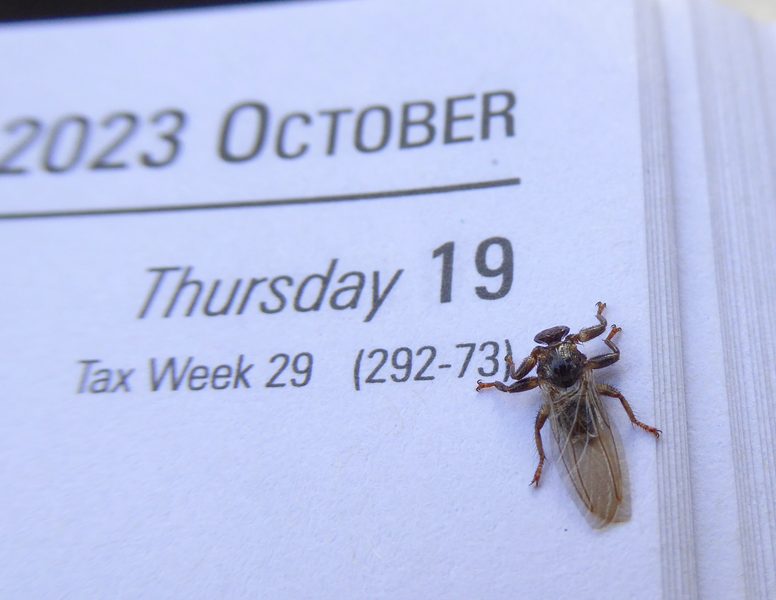
Keds are therefore difficult to swat or swipe off your person or clothing. No matter how hard you try, they stubbornly cling on. And when swatting fails, which it inevitably will, you must resort to actually pinching them between your thumb and forefinger in order to remove them. That’s when you encounter the famous wriggliness.
That’s what sets them apart from other biting beasties – they are so extraordinarily robust. A ked feels strong and defiant between your fingers, and its peculiar wriggling arguably gives it a unique ick factor. A lot of people are unsettled by insects in general, but I think keds turn that up a notch. And yet, for all their wriggling, they can stow away unseen and unfelt for quite a while, only to reveal themselves at the most inconvenient moment. Usually when you’re driving a vehicle or sitting at home watching the telly.
This ability is nicely summed up by this tweet I made a couple of years ago:
‘Yay, it’s that season again when THESE come crawling out of your collar / hair / beard etc long after you’ve closed the door to the outdoors.’
Coming to think of it, I remember a colleague at Mar Lodge telling me how she was in the Co-op buying something, when a ked fell out of her hair onto the counter in front of the cashier. To be fair, that’s not likely to draw even a raised eyebrow in this neck of the woods, given most folk here are likely familiar with keds.
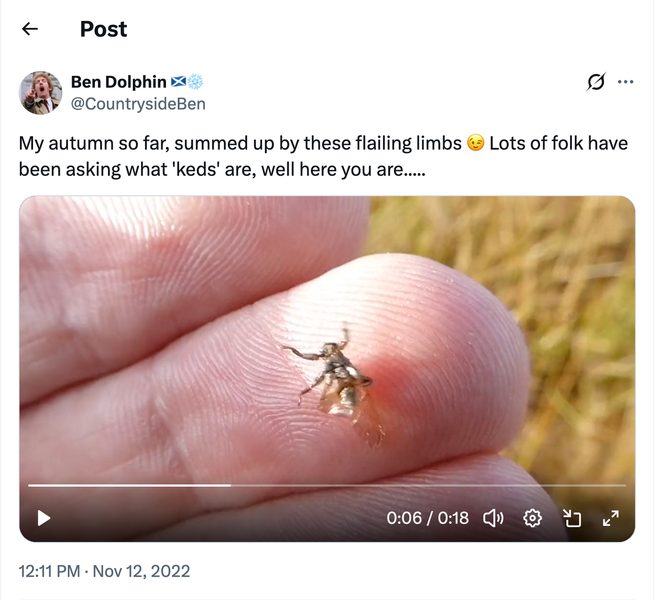
It does amaze me, though, how many people look blankly when I mention keds. Sometimes, when I explain what they are, and start describing their physical characteristics and what they feel like when they land on you, the penny drops for a proportion of those people. They know the culprit, they just don’t know the name. Even so, I still find it surprising just how many people are still look blankly back at me even then.
Given they’re so uniquely weird and unsettling, it’s odd they’re not more widely known, as a ked encounter isn’t something you’re likely to forget. Ticks, midges and clegs are all very familiar, but for some reason keds seem to go under the radar.
I think there is, however, an element of surprise when keds appear for the first time in any given year. They typically do so in early autumn, a time when you’re watching the colours change, the midges subside and, with those first cold nights appearing, you’re daring to believe you’re in the clear from annoying wee beasties as summer winds down. But no. They pop up at the onset of autumn, shouting “Hey! You forgot about us, didn’t you!?”
In my experience keds tend to peak in late September, but they can linger well into November in the warmer years. Most years, they’re only an occasional background menace for your average outdoors enthusiast, but some years do seem to be worse than others, as this tweet from 2021 reminds me:
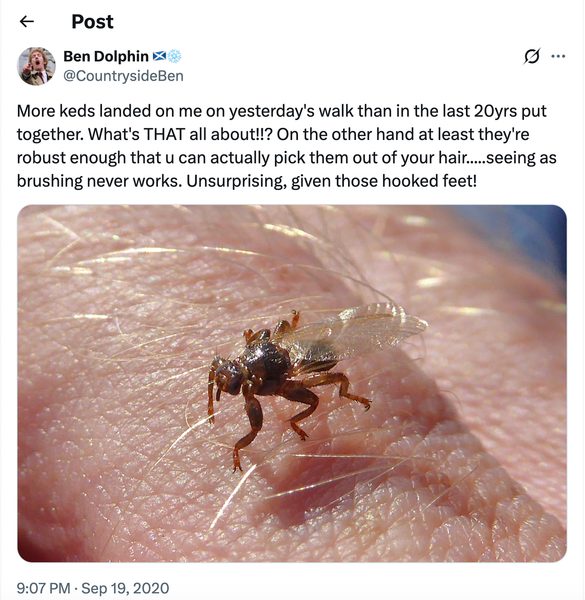
That was on a walk up Fraochaidh, near Ballachulish. As in Glen Lui, that was also a lovely warm, calm, sunny day. Perfect ked weather, it seems.
At the time I described the encounter as though keds were falling out of the sky like rain, and indeed that’s always been my perception of how they arrive – i.e. from above. And so when the ked swarm in Glen Lui appeared, just as I passed under a large solitary tree, I reasoned that the same thing had happened. They’d descended towards me from above. That evening, therefore, I googled: ‘do keds hang out in trees?’
Do keds hang out in trees?
Apparently not, no. Keds aren’t built for repeated flights, and struggle to fly further than 50 metres, so like most of our biting beasties they will sit and wait in low-lying vegetation and then ambush their target host animals when they pass.
I’m therefore guessing that the reason keds seem to come at you from above, is because they presumably must aim high when you walk past. To be fair, they’d typically be aiming at a much larger animal than you – deer – so they presumably think that’s what you are.
Keds can’t complete their lifecycles on a human host though, which tends to suggest they’re not great at telling the difference between us and a deer. But given they’re weak fliers, they presumably can’t afford not to chance it, and so inadvertently land on non-target species, including livestock and other large animals.
Wings falling off
When they do land on a suitable host, their wings fall off, which instantly makes it easier for the smooth, flat ked to burrow down into the animal fur. Losing wings in this way is called ‘dealation’. ‘Alation’ means being in a winged state, and so ‘de-alation’ is to lose that state.
Queen ants do the same after they find or establish a nest. They will live underground in narrow tunnels and chambers from that point, and having large wings would be a hindrance rather than a help.
Ked wings aren’t as securely attached to their bodies as on other insects. They’re robust enough to get the ked airborne and to a prospective host, but fragile enough to be prised off through a combination of friction and resistance within the fur. I’ve seen a wingless ked a couple of times when I’ve picked one off me, and it looks even weirder than the winged version! I’m not surprised that some folk mistake wingless keds for ticks when they see them.
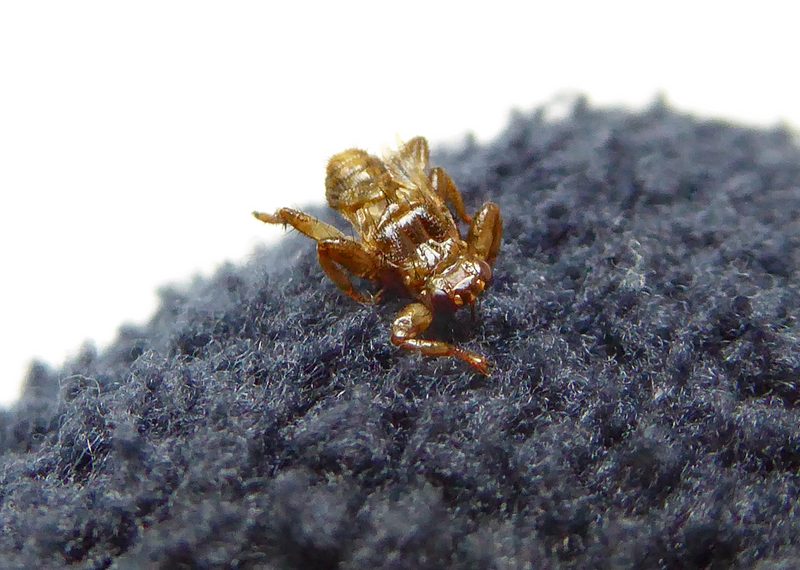
For the ked, jettisoning its wings is quite the commitment, because once that happens they’re stuck where they are. No second chances. But interestingly, that’s not the only physical change that keds undergo when they land on their host. A study published only this year, by Aberystwyth University and the University of Florence, found that once a ked had settled on a host, the activity of the genes governing its visual sensitivity decreased. After shedding its wings, the ked’s visual sensitivity was found to diminish by at least half.
This is because thereafter, in dense animal fur, touch is more important than sight. Diverting resources away from sight is thought to save the ked valuable energy that it can otherwise spend on reproduction (they find their mate within the fur) and feeding.
These rapid changes are essential, because after the ked has lost its wings, it will live the rest of its life within the animal fur. Fur provides a stable microclimate where the female can effectively live and breed, protected from the worst extremes of weather, and keep at a fairly constant temperature.
Less is more
As with the other ectoparasites we’ve encountered this summer, keds need to feed on protein-rich blood to reproduce and complete their lifecycle. And because of their unusual reproductive strategy, keds in particular need a lot of energy for their young to develop.
Unlike many insects, deer ked young are not born as eggs. They’re born as live larvae, which develop within the female and are nourished internally until birth. It’s more usual in the insect world to have LOTS of offspring, producing thousands in order to overcome the pitiful odds of surviving to adulthood. If we compare keds to our other recent subjects, clegs lay hundreds of eggs, ticks lay thousands, but ked offspring appear to be in mere double digits.
It’s a fascinating trade-off. Giving birth to well-developed larvae gives them a head start and increases the survival chances of the next generation, but because it requires so much energy to get them to that stage, the ked can’t give birth to anywhere near as many young as the other wee biters we’ve encountered. That’s why keds feed repeatedly in the effort to reproduce, rather than the single feeds (per life stage) for ticks. The regular and rich blood meals mean it only takes about a week for each larvae to develop (one at a time of course) within the female.
As an adult, keds that successfully find a suitable host animal will live for about a year. I’ve seen different numbers cited, but between the moment she mates on a host in the autumn, and the following spring, most sources suggest that a ked will give birth to between 20 and 30 larvae. An incredibly low number for an insect.
After birth, the wingless larvae fall to the ground and pupate, emerging as adult keds in the autumn. Interestingly, even though the female is constantly giving birth throughout her adult life, and her offspring therefore fall and start pupating at different times, their emergence is generally synchronised for the autumn. And when that next generation of keds emerge, they sit and wait for a prospective host, and the cycle begins again.
The reason for my ked hotspot in Glen Lui the other week, therefore, would evidently be because at some point in the previous year, a host animal (a deer, presumably) passed under that scots pine, perhaps lay down or took shelter, and unwittingly deposited a deer-full of newly emerged ked larvae. In that patch of heather the keds pupated, slept-out the winter, and then emerged just a short time before a hapless ranger came strolling past with his camera.
I have to say, 50 keds on my person felt like plague proportions, but that pales next to what a moose has to contend with. There are single moose (mooses? meese?) in Finland that have been found to have as many as 17,500 keds living in their fur! Good grief!! I know moose are very large but that’s ridiculous!
In Scandinavia, infestations of keds can lead to hair loss in moose, increasing mortality due to reduced insulation in wet and cold weather. For humans though, the impact of keds depends very much on the number and density of keds in the landscape.
Do keds bite us?
Clearly, with all this talk of the ked’s need for thick animal fur for insulation and protection etc, humans are not the ked’s target host. But that doesn’t mean they can’t or won’t bite us. I stubbornly refused to believe that keds bite humans, purely because of the flawed logic that it had never happened to me personally. It didn’t matter that other folk kept telling me they’d been bitten by keds, I never believed it. Not until the autumn of 2022, when one did indeed bite me.
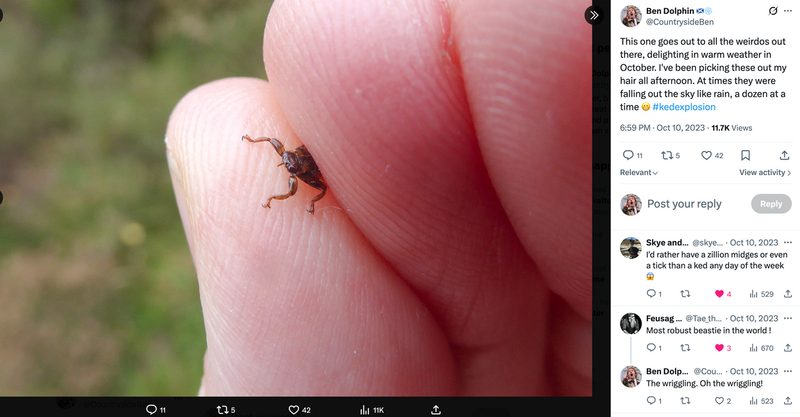
I found a Finnish study that said the ked bite is barely noticeable due to its shallow depth on your skin, but I distinctly recall a sharp sensation on the back of my neck, which had me reaching up to swat away whatever it was. And yep, there was that distinctive wriggling beneath my fingers. The bite later developed into a hard red welt, which was very itchy and persistent.
In Norway, ked profusion has been closely linked to moose density, and it stands to reason that a similar relationship would be found here, linked to the host species in Scotland – deer. We have a lot of deer in Scotland, but the ked problem in Finland appears to be on another level.
Finland in particular suffers significant disruption to outdoor activities – again, often linked to the high density of moose – and this has led to local concern about the levels of dermatitis in the human population. This is because the Bartonella genus of bacteria, which can be transmitted to humans via a ked bite, can cause aches, pain, fatigue and, yep, dermatitis.
Some studies in Finland have also found that keds can inadvertently release airborne allergenic particles that can cause sneezing, itchy eyes, nasal problems etc, although apparently such reactions are only likely to occur when there has been ‘significant exposure’ i.e. the kind of places where your average moose has 17,500 keds on it!
But repeated exposure to ked bites has been shown to have longer-term health impacts, as one Finnish study explains:
‘After deer keds were present for about 20 years in eastern Finland, one third of regularly exposed forest workers became sensitised to the bites’, with new bites causing flare-ups of old bites or symptoms.
Interestingly, deer keds also have a relationship with Borrelia, the bacteria that causes Lyme Disease. Borrelia DNA has been found in Lipoptena cervi in Poland, Czechia, the USA and Japan, but as far as I can tell, there’s no documented incidence whatsoever of Lyme Disease being acquired via a ked bite. Consensus seems to be that keds and ticks just don’t work the same way, and that keds can’t be vectors of Lyme Disease. That’s good, obviously, but it doesn’t make me any more likely to let a ked crawl around on me for longer than necessary!
Thankfully, keds aren’t a major nuisance here in Scotland, not for most people at least. But the Scandinavian experience does offer a glimpse of just how unpleasant an encounter with a swarm of keds can be, and how disruptive they can be to outdoor life. For the moment, keds are an icky nuisance in Scotland rather than a serious health hazard or an active deterrent to outdoor activities, but with warmer autumns likely resulting in a longer ked season before winter sets in, I dare say the weird, wriggly keds will become far better known across Scotland than they currently appear to be.